
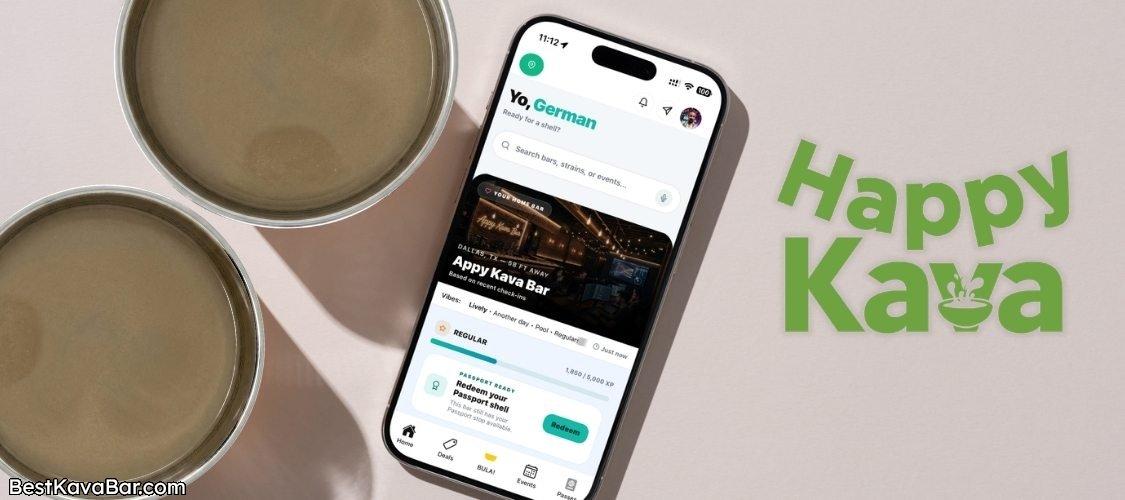
A few months ago, HappyKava was a much simpler thing.
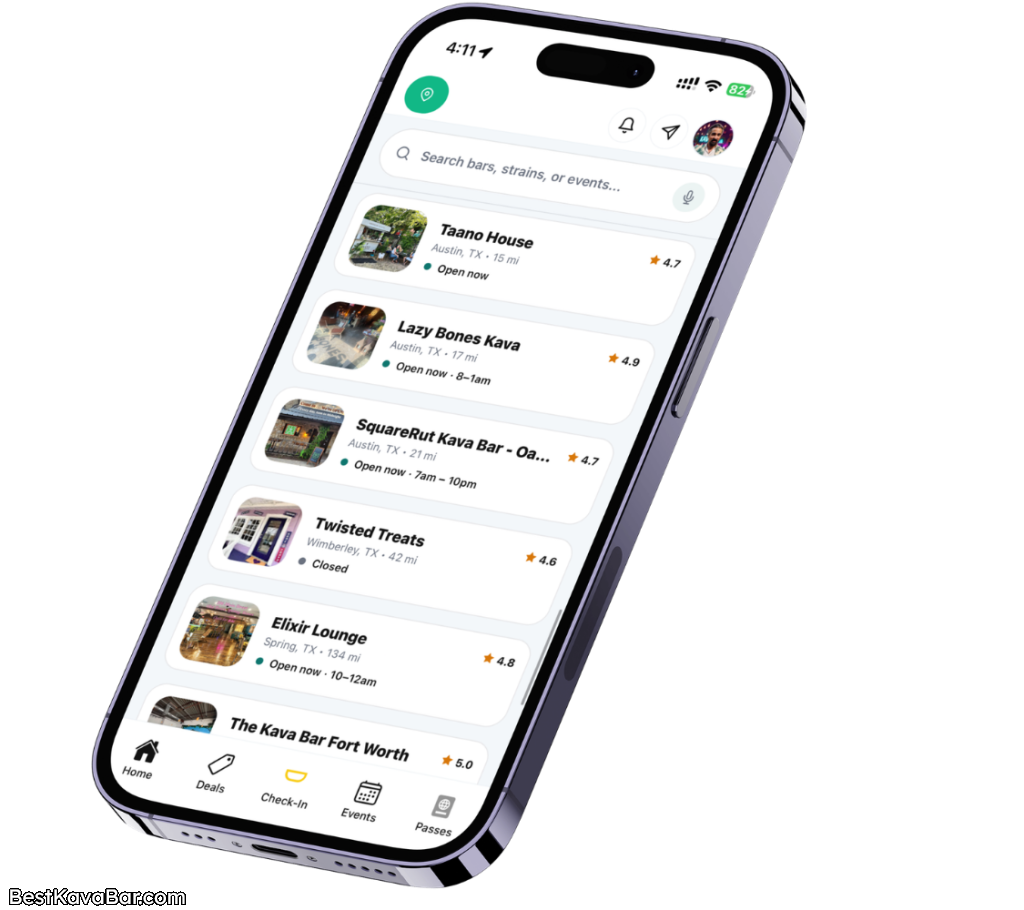
It was an app to help people find kava bars, see some deals, maybe discover an event, and figure out where to go next.
Useful, yes.
But still just a utility.
That version of HappyKava made sense on paper. It followed a roadmap. It had a clear shape. It was moving in the direction I thought it should go.
Then real people started using it.
And everything changed.
From Winter v2 to Spring v3
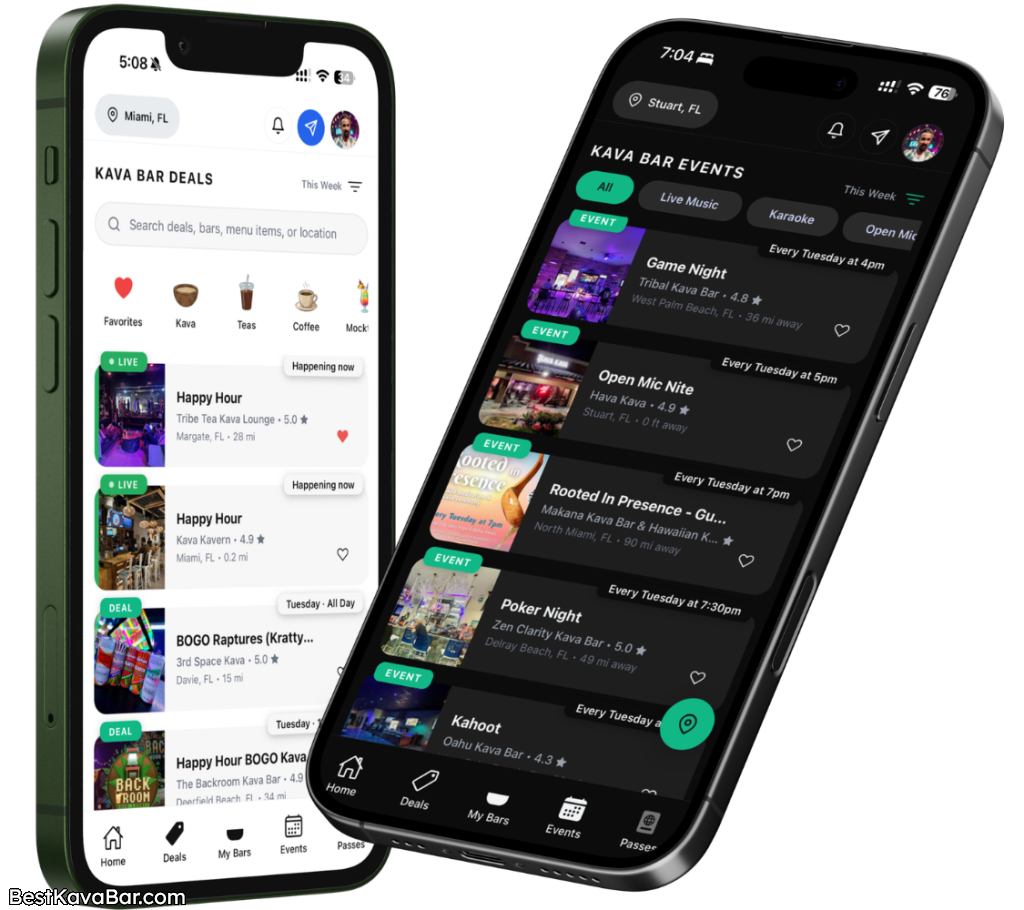
At the end of last year and the beginning of this year, the plan was pretty straightforward: build a great kava bar app.
Discovery. Deals. Events. Check-ins. Keep improving it.
But when I launched the MVP into the real world in October and started using it while traveling, one thing became obvious right away: this wasn’t just about helping people find bars. TravelRoot was one of the few ideas from that original era that stayed completely intact. The idea that your app should understand where you are, where you’ve been, and where you’re going still felt right from day one.
Almost everything else evolved.
Within the first few weeks, dozens of kava bars signed up. And almost immediately, I started hearing the same message from owners:
“I like this, but I can’t manage all of this from a phone.”
That single sentence changed the entire direction of the product.
The app was originally supposed to be the product.
Instead, v2 became the beginning of a very long journey into building not just a consumer app, but a full platform: mobile experiences for users, business-facing tools, staff flows, and a huge web dashboard running alongside the iOS and Android apps. At one point, I was basically building five different products at once, solo.
And when bar owners first started using the dashboard, the feedback was mixed.
Some were excited.
Some were quietly happy.
Some said nothing, then disappeared.
The analytics showed why. It was too time-consuming. Too much setup. Not enough payoff yet.
That’s when I realized something important:
If HappyKava was going to work for bars, it couldn’t just be another place where they list things. It had to make growth easier. It had to make operations easier. It had to make marketing easier. And if it created more work, it had to create a lot more value in return.
The first real leap: a one-of-a-kind deal system
That realization led to the first major shift.
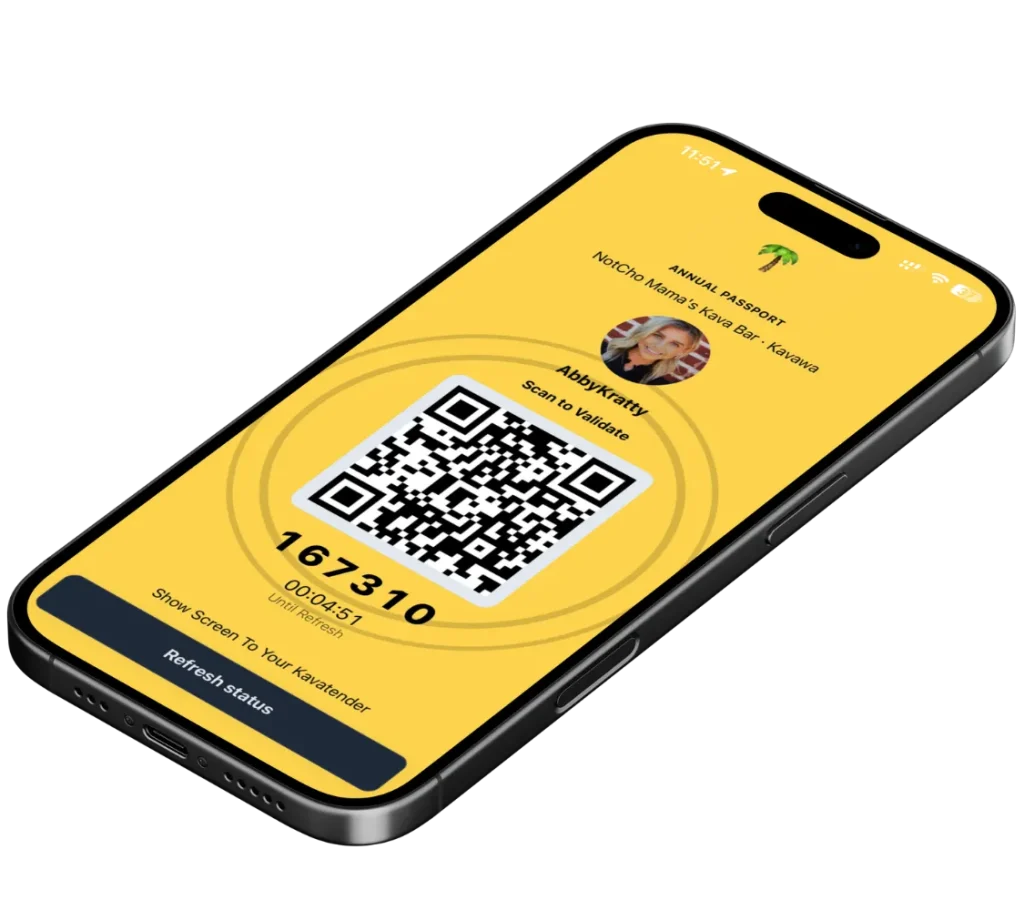
I built out a full Deal Pass system so bars could do things that a normal directory or promo app simply couldn’t do:
- redeemable Always Happy Hour passes
- time-sensitive deals that users could actually claim
- dynamic happy hours
- popup deals for slow hours
- instant push notifications
- geo-aware targeting so bars could reach the right people in the right moment
That last part mattered a lot.
The whole point wasn’t to blast everyone with generic promotions. It was to make sure that if a bar suddenly wanted to run something fun, spontaneous, or urgent, the app could reach the people who cared and were actually nearby enough to act on it.
Not some giant text blast hitting a loyal customer who was three hours away.
Not someone on vacation in Japan.
Not someone who hadn’t been active in months.
The system had to be smart.
That whole direction became one of the first real signs that HappyKava wasn’t going to stay just a “find a bar” app. The app overview already reflected this shift clearly: deal passes, Always Happy Hour, First Cup, live check-ins, staff validation, and dynamic deal systems had all become core product infrastructure, not side features.
And it worked.
Bars responded well. The idea landed. It felt new. It felt useful.
But then the next problem became obvious.
We needed more users. Fast.
Passport changed everything
That’s where Passport came from.
The idea was simple:
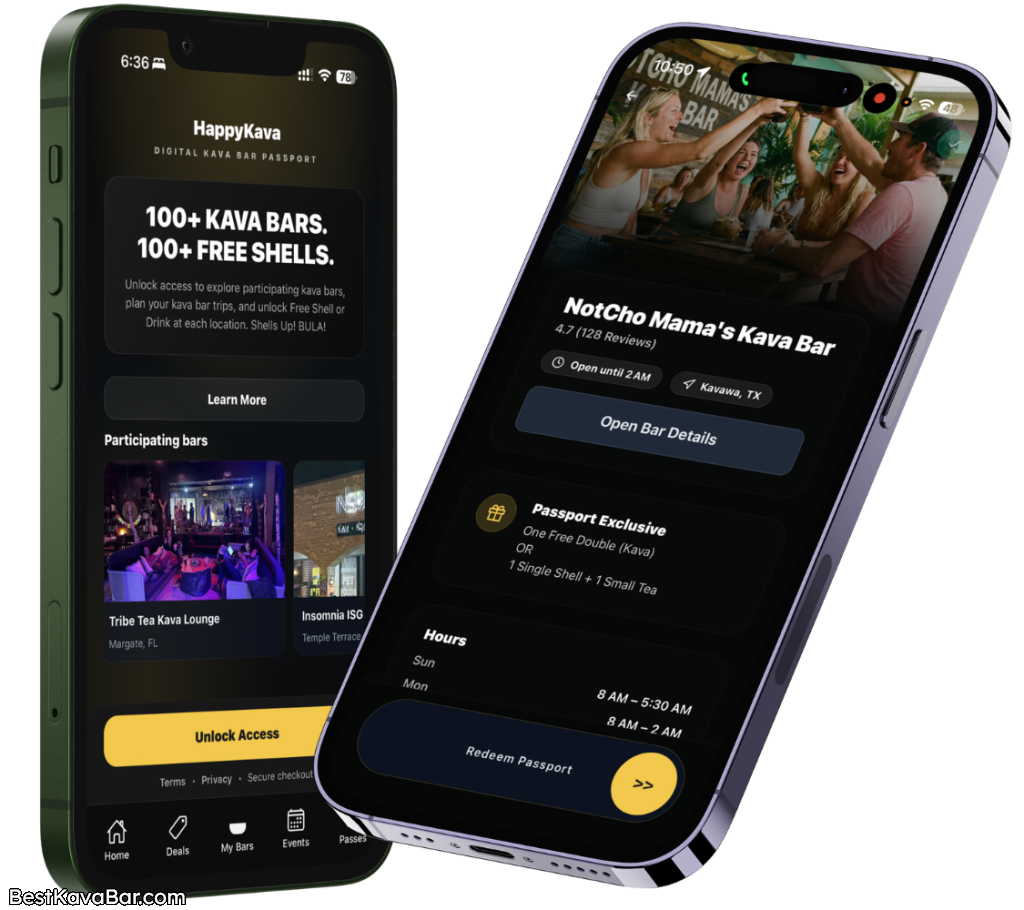
What if people could use HappyKava to explore kava bars all over, and get one included drink at each participating location?
Not as a coupon. Not as a gimmick. As a reason to explore the kava world with confidence.
On the product side, I was lucky. I had already built the backbone for it with the pass system.
But the technical side turned out to be the easy part.
The hard part was everything else.
I ended up negotiating with more than 200 kava bar owners.
Over 170 were interested in Passport at some point. More than 60 backed out before launch for all kinds of reasons. Thankfully, we still had over 100 participating bars, which was enough to honor what we had guaranteed preorder customers. The Passport FAQ itself was built around that promise: one included drink per participating bar, nationwide exploration, and a growing list of participating locations.
But the bars that said no were often the most valuable conversations.
One owner said, “We tried making our own app. Customers didn’t use it. Waste of time.”
Another said, “We have our regulars. We don’t want a discovery app pulling them away from us.”
Another told me, “This should be more like a social network. I’d love for this to replace our messy group chat with regulars.”
And of course, there was the one I heard constantly:
“This is too much work. I’m too busy already.”
That feedback shaped v3 more than any original roadmap did.
Because they weren’t really telling me what to build.
They were telling me what they feared.
They feared more work.
They feared wasting time.
They feared building into something that wouldn’t become part of daily bar life.
They feared “discovery” becoming customer leakage instead of customer growth.
I heard that loud and clear.
Apple slowed us down — and the market didn’t wait
Then came one of the toughest moments in the whole journey.
We hit Apple-related delays that cost us about three weeks right when Passport momentum was building.
That delay hurt in a very specific way: it crushed the preorder runway.
We had originally planned to let users preorder Passport in-app for about a month.
Instead, we got less than a week.
That meant user interest was rising, bars were getting secured, and Passport buzz was growing — but many new users were still downloading an older version of the app that said nothing about Passport at all.
So growth came in, but churn came with it.
If you already knew the story, you stayed.
If you were new, downloaded the app, and didn’t see what everyone was talking about, you often disappeared.
That was painful.
But I didn’t spend those weeks waiting around. I used them to keep talking to bar owners, locking in participation, gathering objections, and understanding what the next version of HappyKava had to become.
The bugs were not theoretical
There’s a romantic version of startup building, and then there’s the real one.
The real one looks like this:
- bars couldn’t post new events for a week
- users on smaller phones had trouble getting through signup
- Yahoo blocked confirmation emails
- QR code validations broke during peak Passport usage
and the only reason that didn’t become a total disaster was because I already had two fallback systems in place
Those aren’t “nice-to-fix-later” bugs.
Those are real-world, live-business problems.
A customer is standing there.
A bar is busy.
A staff member needs the thing to work right now.
So you stay up and fix it.
There were 72-hour nonstop development and design stretches in this era. Solo. Not because I think that’s some badge of honor. Because the product was alive, and alive products don’t wait politely for the next sprint.
The roadmap became an anti-roadmap
At some point, I stopped thinking of the roadmap as the thing steering the product.
Because it wasn’t.
The product was steering the roadmap.
And the more I listened, the more obvious it became that HappyKava had to become something almost opposite of what many bar owners feared.
We made a discovery and deals app.
A lot of them wanted an anti-discovery retention app.
And users? Users didn’t want a prettier Yelp. They didn’t want a utility app they open on the way there, then forget until they leave.
They wanted to know:
- what’s going on right now? later?
- who’s there? who’s working?
- what’s the vibe?
- do they have my favorite?
- where’s the next kava bar?
- where is the best deals?
- why this bar, at this moment, matters
- are my friends at the bar right now?
- when’s the next BULA? I don’t want to miss it.
And they wanted to pull out the app while sitting at the bar, not just before or after.
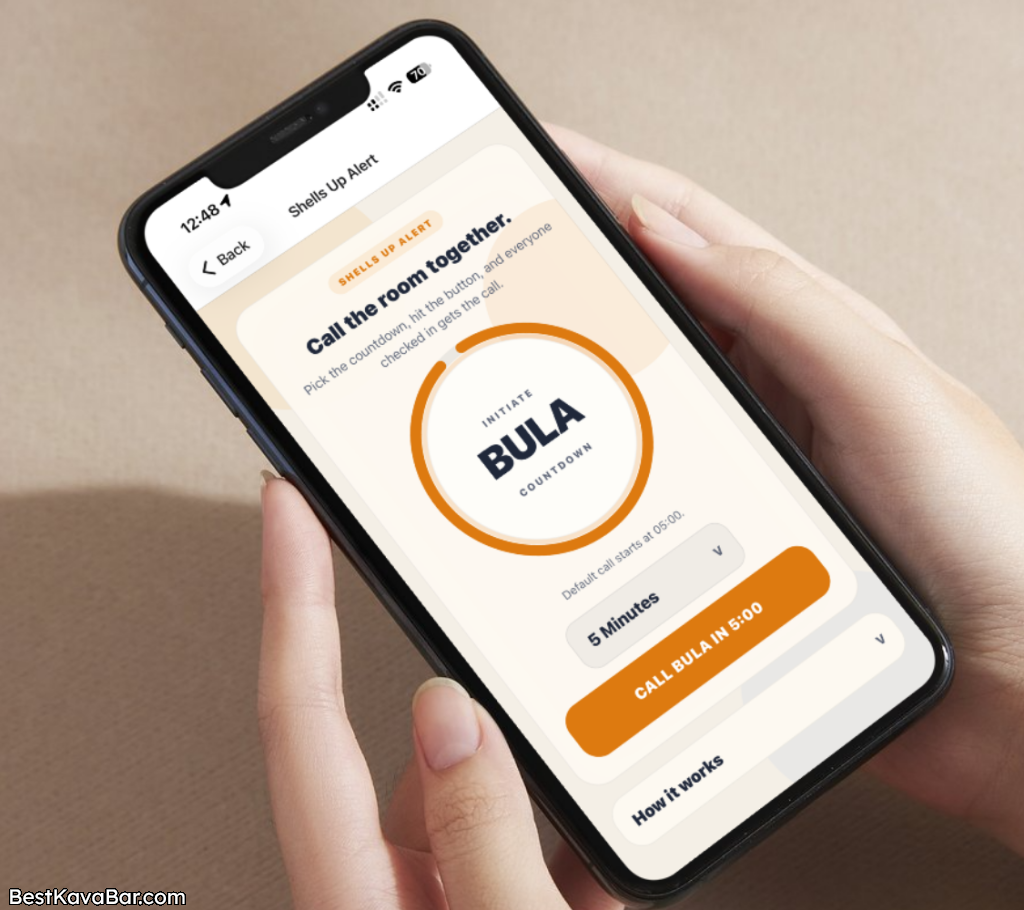
That’s what really shaped v3.
v3 became much bigger than originally planned
By the time v3 started taking shape, HappyKava had become a huge endeavor.
Not just a refreshed app. A whole ecosystem.
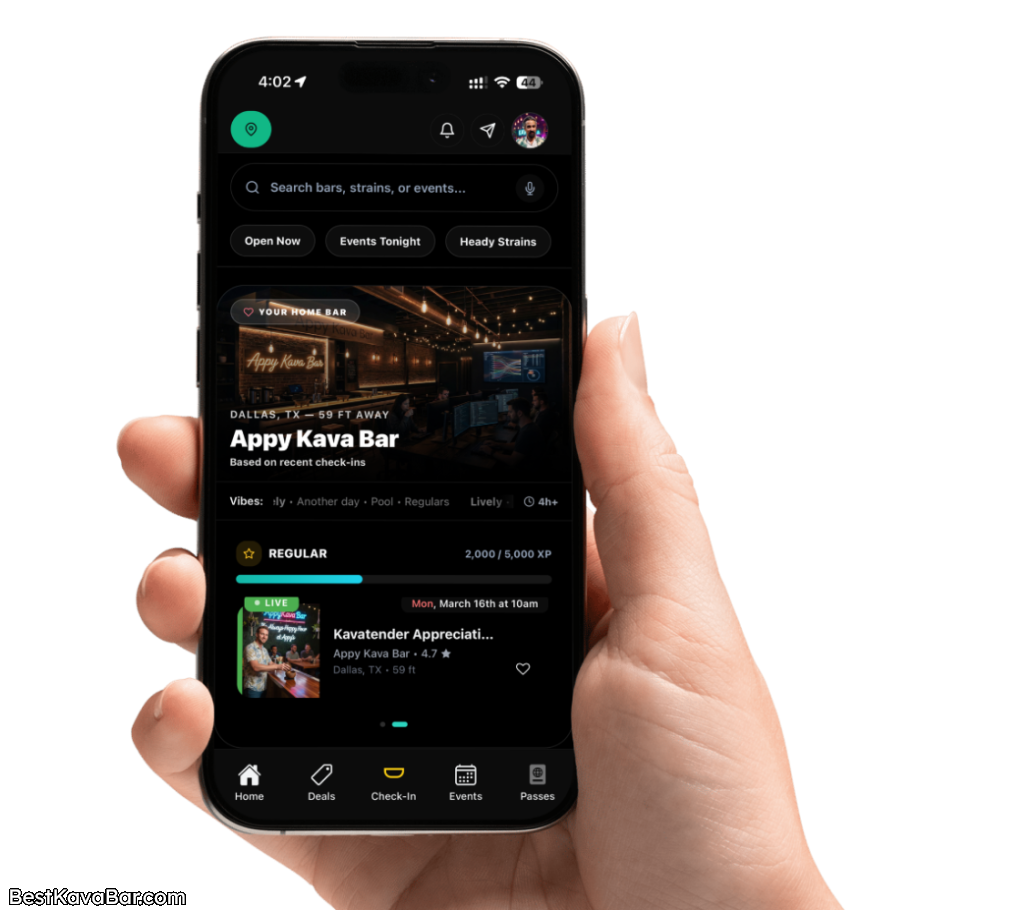
For users, that meant:
A redesigned v3 home screen that became more alive, more stable, and more useful in real-world conditions. Instead of behaving like a fragile list, Home became a real-time starting point for what’s happening nearby and what matters right now.
Home Bar became a real system, not just a preference setting. Users could center the app around a favorite bar, make that bar part of their identity in the app, and use that as a starting point for discovery, return visits, widgets, and travel context.
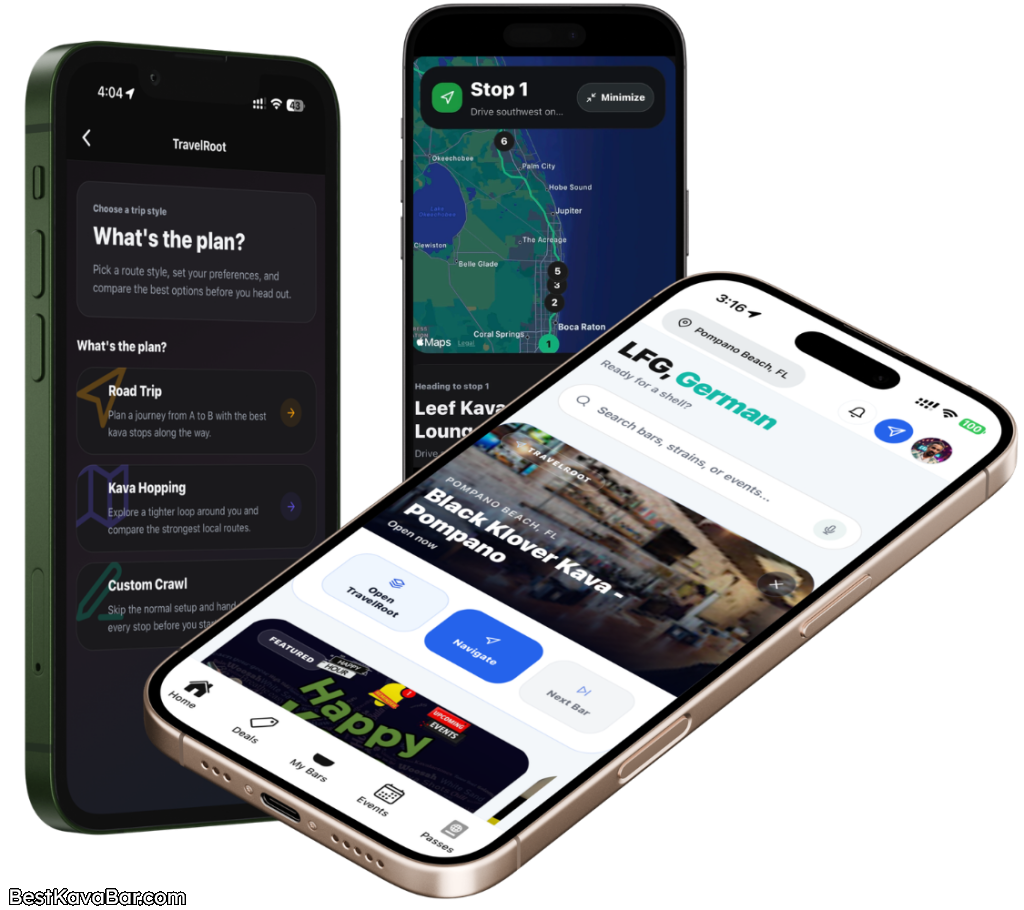
Passport became more than a pass. It became a guided way to explore the kava world with confidence, with included drinks, bar-specific terms, and a clear reason to visit new places.
Regulars and revisit loops started emerging as the other side of Passport: not just exploring bars, but returning to the ones you love. The app overview already frames this as “Passport for discovery” and “Regulars for loyalty,” which is exactly how it started to feel in practice.
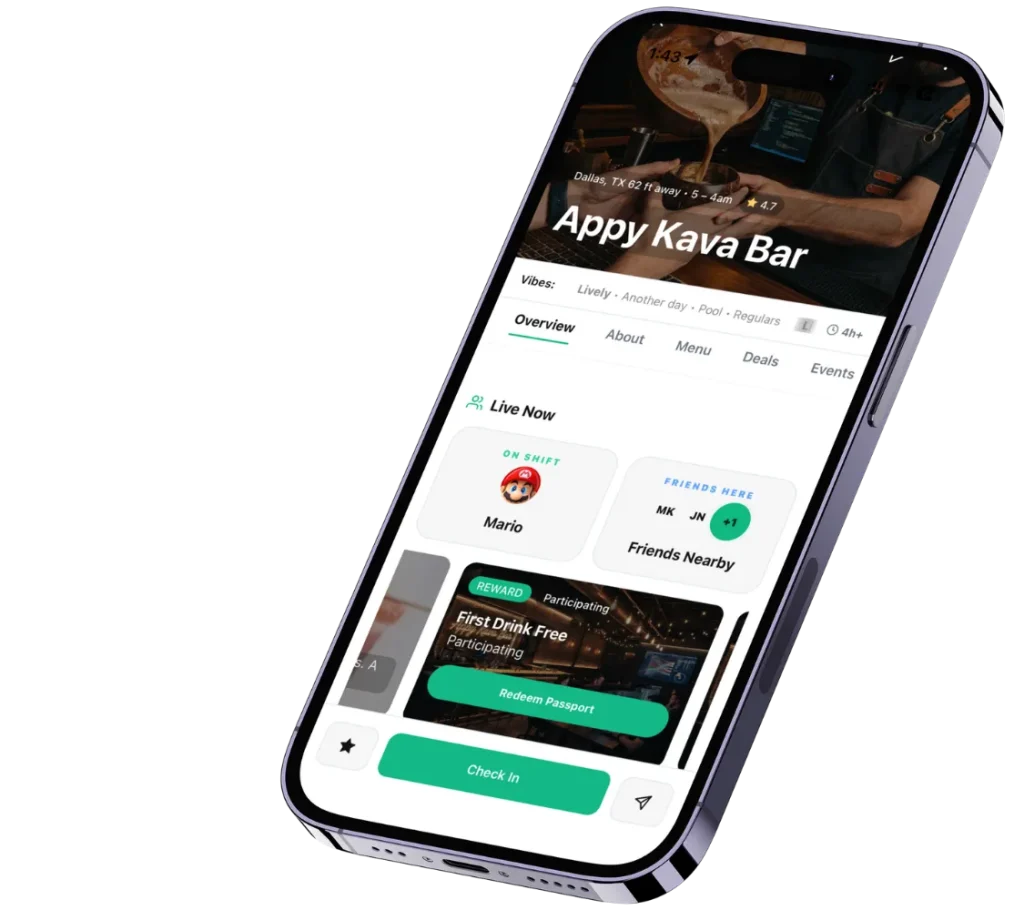
The whole social and emotional layer got deeper too:
- live vibe
- who’s working
- revisit cues
- better review systems
- share flows
- friend/referral loops
- more reasons to keep the app open while you’re at the bar, not just before you arrive
And then there’s BULA RUSH.
If you think BULA RUSH is a simple little bar game, that’s only because it’s disguised like a sleeper car.
Take one look under the hood and it becomes obvious: absolutely not. It’s a monster.
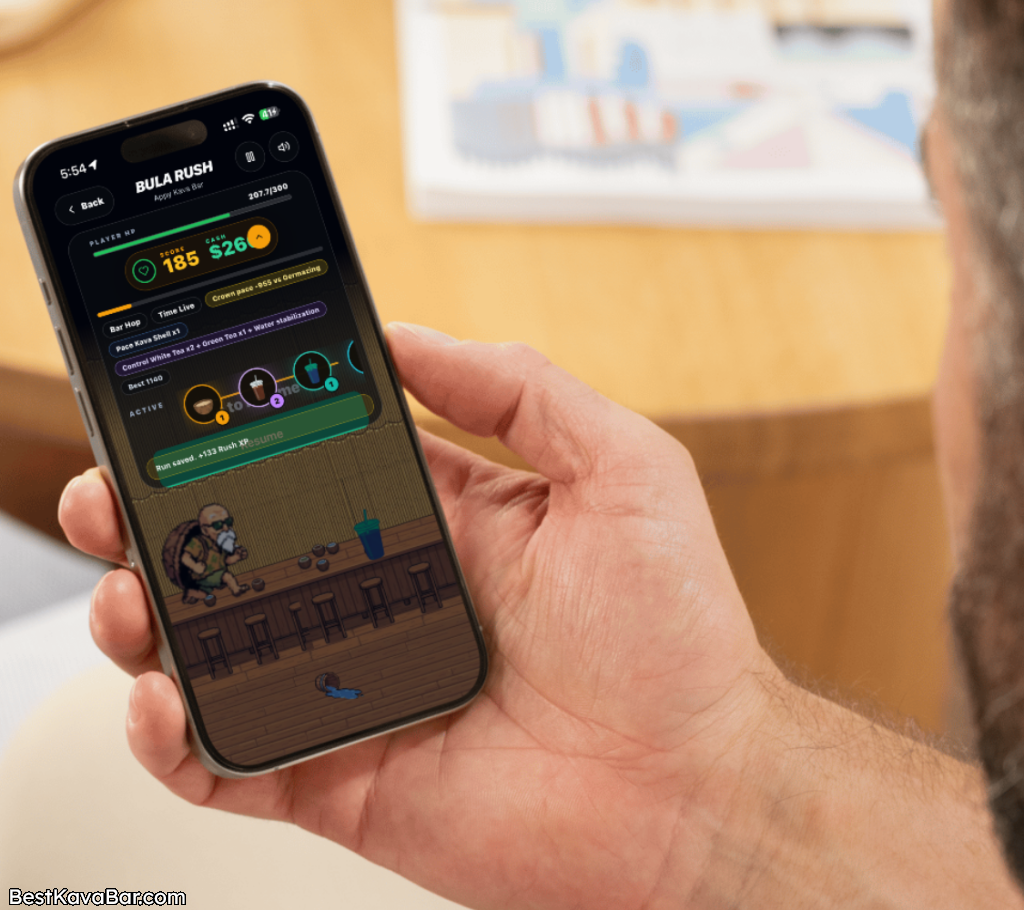
It’s a real bar-based game platform with:
- custom playable characters
- custom scenes
- custom powerups
- in-game music
- familiar NPCs in the background
- bar-specific leaderboards
- bar-only access while you’re physically there
- even an ad hoc 2-player mode
The BULA RUSH spec makes it clear this thing is far beyond a throwaway mini-game. It’s a bar-aware runtime with modes, leaderboards, player progression, sponsor integrations, custom content pipelines, and location-based access gating.
That’s not filler. That’s culture-building software.
For bar owners, v3 became even bigger
This is where the product really exploded.
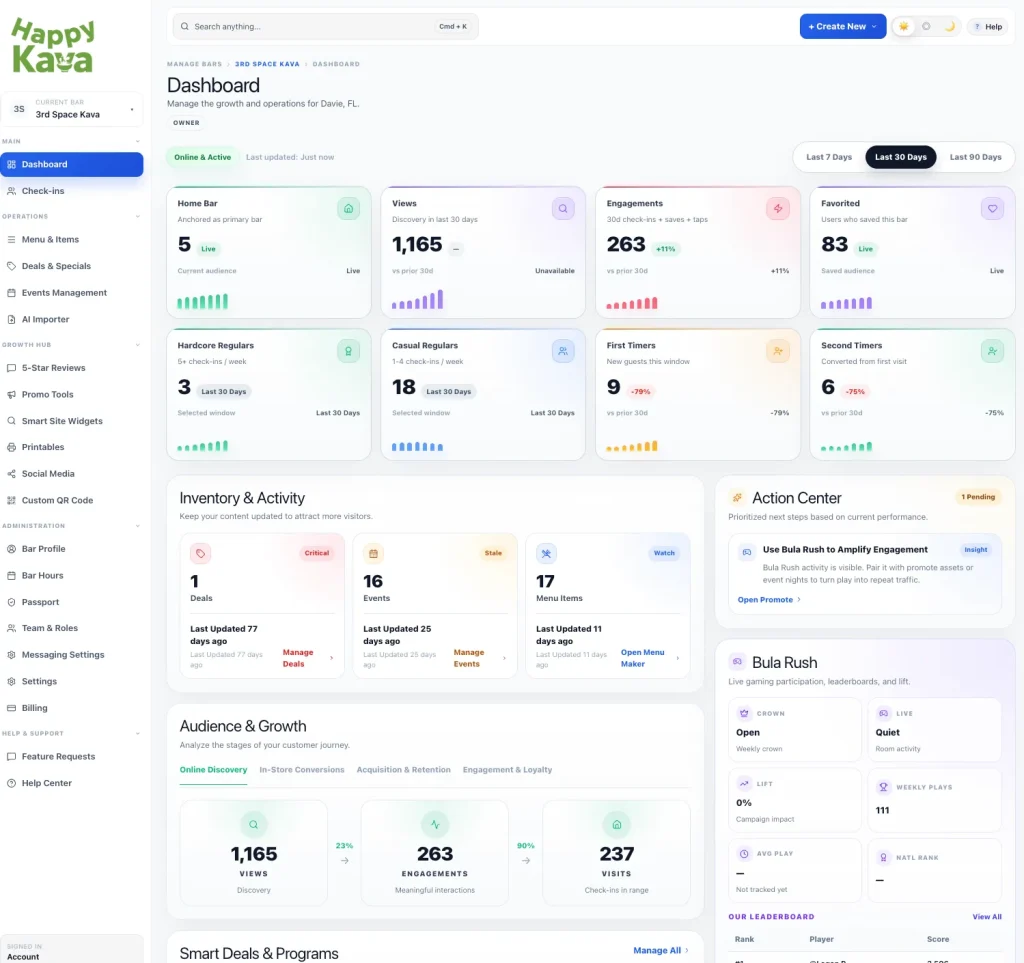
The biggest unlock for a lot of bars was not a consumer feature at all. It was Menu Maker.
An item-by-item menu system sounds great in theory and like a nightmare in practice. More setup. More work. More fields. More maintenance.
Until the AI Importer changed it.
Once that landed, bars could set up their full menu, deals, and events in under five minutes, with near-perfect accuracy. What was previously annoying, time-consuming setup suddenly became one of the fastest parts of onboarding.
And then the growth tools expanded way beyond what the old roadmap ever really implied.
Bars didn’t just get listings.
They got a full growth suite:
- interactive website widgets for deals, events, and menus
- weekly and monthly calendars they could drop into their websites
- customizable menu widgets that match their site’s look and feel
- simple copy/paste code
- the ability to stop manually updating their site every time something changes
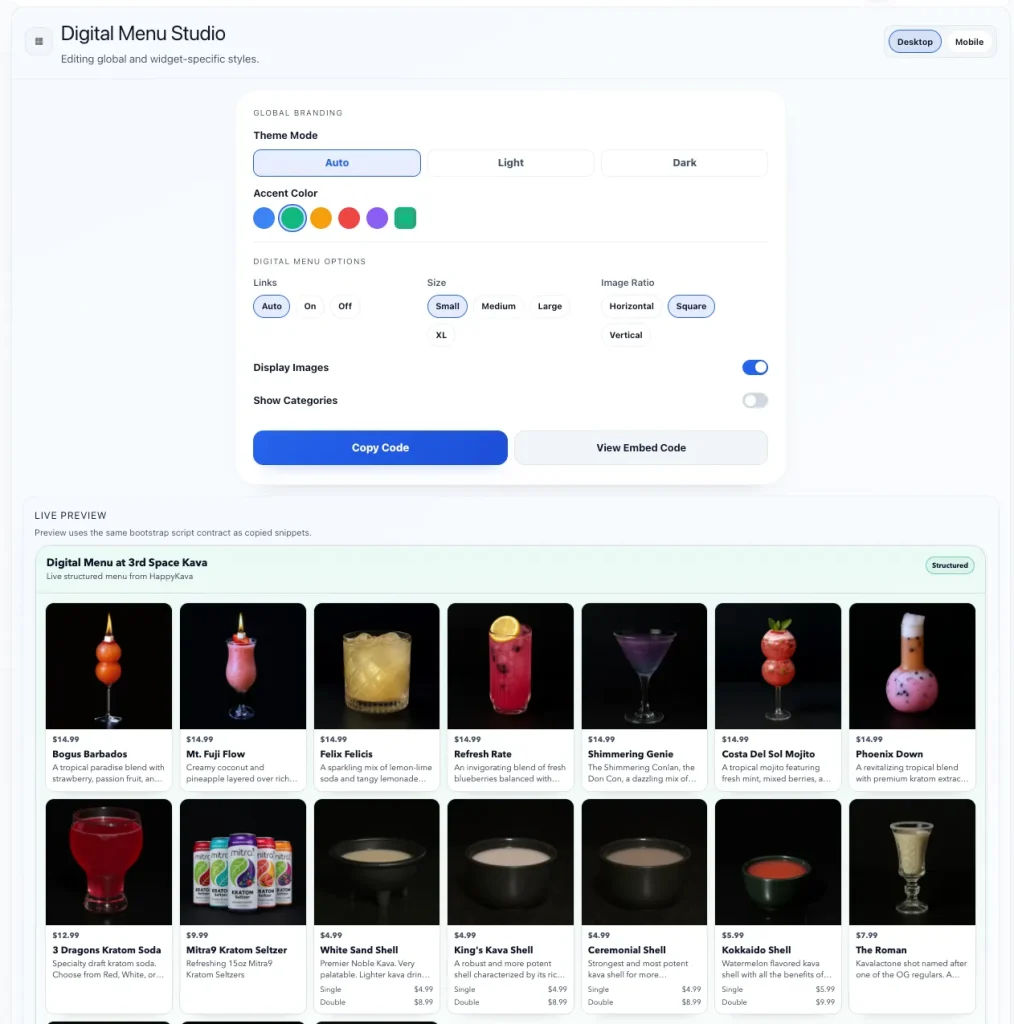
That alone is already a product.
Then came Printables.
Bars could generate flyers, posters, postcards, and QR-driven materials that didn’t just open the app — they could trigger actions.
Scan to make this your Home Bar.
Scan to play this bar’s custom BULA RUSH game.
Scan to jump into the right place in the app and actually do something.
That’s a very different kind of offline-to-digital bridge than a normal QR code.
And of course, a full printable menu in dozens of different styles, formats and fonts based on the Menu you imported in 2 minutes easier.
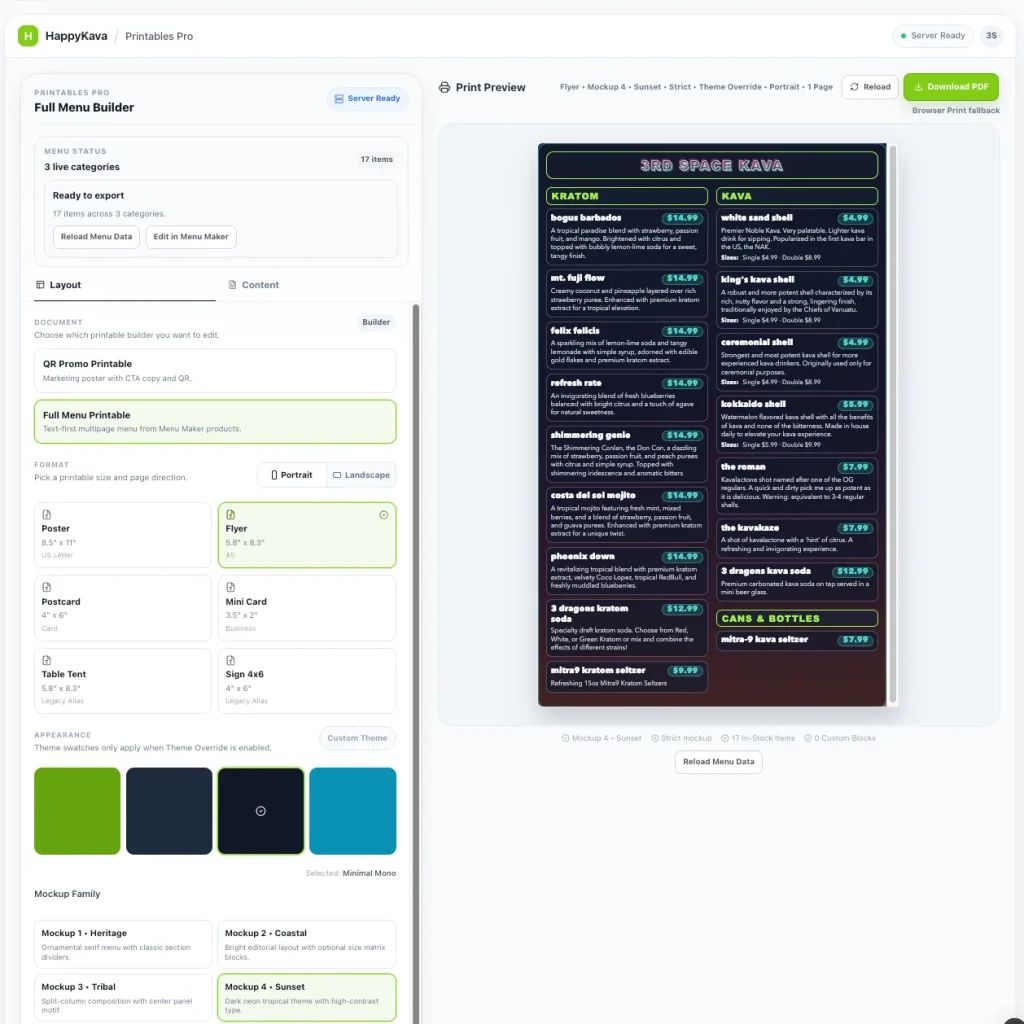
And then came social media tools:
ready-to-post images and slideshow content built directly from a bar’s real data — its menu, deals, events, logo, images, schedule, and vibe — so bars could create actually good promotional content in a few clicks instead of starting from scratch every time.
Again: this should probably be its own product.
And then there’s the reviews system.
The reviews side got massively rethought in v3 as well. Not just “leave us a review.” More like a whole system that connects:
- smart signals
- push notifications
- easier user flows
- deal passes
- shareable referral codes and links
- first-timer moments
- regular-building loops
So that one great night out doesn’t just disappear. It turns into online reputation, repeat visits, and new people coming in through people who already loved the bar.
That alone could be a standalone company.
For now, kava bars get first dibs.
And then two new user types showed up
At some point, two new groups entered the picture too:
- ready-to-drink brands and sponsors
- wholesale vendors
And they had their own very obvious needs:
reach consumers directly, in context, without constantly getting throttled or slapped around by Google and Facebook.
That pushed HappyKava into yet another direction: becoming not just an app and not just bar software, but also a highly targeted advertising and growth channel for brands and vendors who already know they want to be in this space, to users who want to drink their products or find a kava bar nearby who has it in stock, and share with kava bars what the search demand is in their area for different product, and what they should add/keep in stock to keep patrons happy, attract new ones and boost their bottomline.
So what is HappyKava now?
HappyKava v3+ is more than an app.
It’s becoming the future operating layer of the kava bar community.
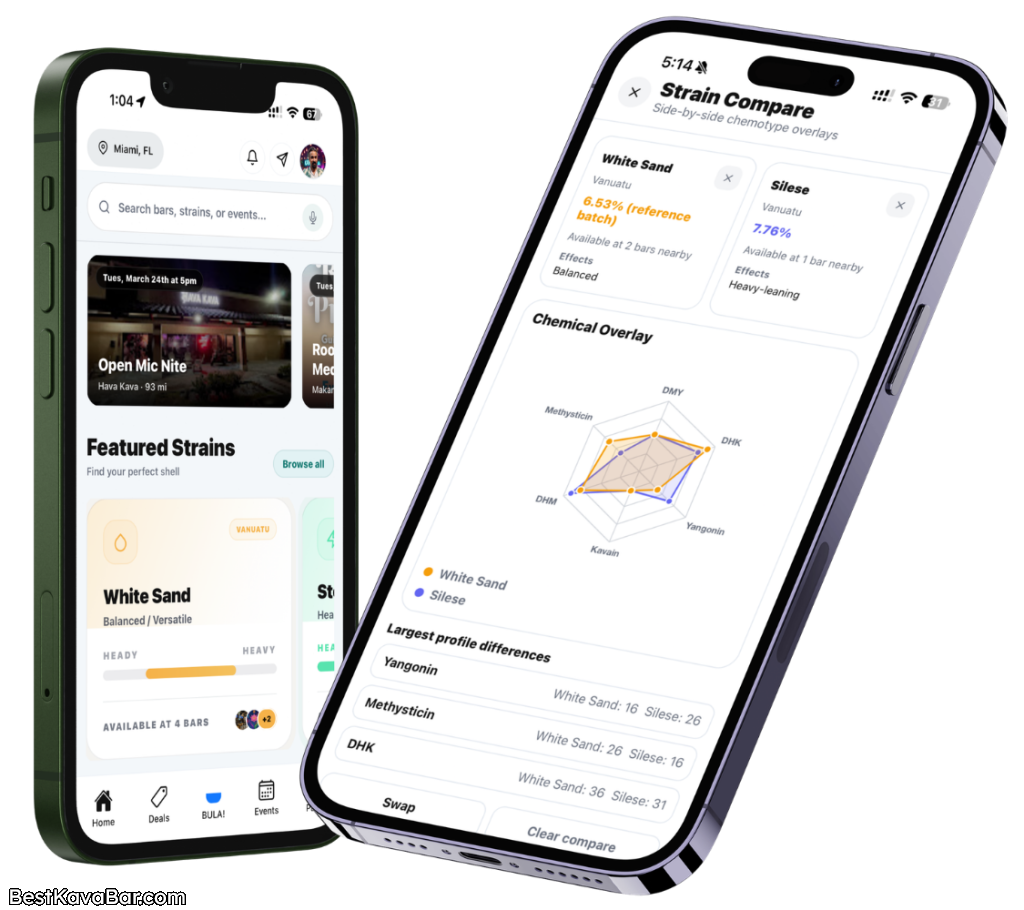
For users, it’s a Kava Bar App that helps you understand what’s happening, where, why it matters, and what to do next.
For bars, it’s a Kava Bar App, SaaS platform, and operating system that helps them grow, retain customers, simplify their workflow, and finally stop juggling six different disconnected tools to run one real-world experience.
And now, for brands and vendors, it’s becoming a direct way to reach people who actually want what they sell.
None of that was fully visible in the old roadmaps.
A lot of it emerged from the pressure of reality.
From bar owners saying no.
From users behaving in ways I didn’t predict.
From analytics telling a different story than my assumptions did.
From bugs, delays, churn, late nights, and relentless iteration.
That’s what shaped v3.
And honestly?
It’s better than the original plan.
Thank you
To every bar owner who said yes.
To every bar owner who said no and told me why.
To every user who kept opening the app on road trips, slow afternoons, and packed nights.
To everyone who helped push this thing into what it’s becoming.
Thank you.
This is not exactly what I planned.
It’s what the community forced me to build.
And it’s much better because of that.
— German
P.S. The roadmap didn’t disappear. It just lost the argument.

Grab the HappyKava App v3 today on the Apple App Store or Google Play Store.
If you’re an owner — signup & claim your bar on the app.
Then head over to HappyKava.app to login to your Kava Bar Dashboard to take full advantage of the mobile app, platform and operating system build specifically for Kava bars.