

1. Train for proof, not time served
A new hire can memorize the menu and still freeze when four people order, a regular interrupts, and someone at the end of the counter says they have never tried kava. “They shadowed for a week” tells you where they stood. It does not tell you what they can do.
Use a simple teaching loop: explain the job, demonstrate it, let the employee practice, then observe them without rescuing every step. Ask them to explain why they made a choice. A correct action performed by accident is hard to repeat.
Keep four assessment marks: not shown, practiced with help, demonstrated independently, and needs another coached attempt. Attach one specific observation to the mark. “Great attitude” is encouraging. “Identified every ingredient and checked the recipe before answering an unfamiliar question” is useful evidence.
One person owns the training plan. Other employees can coach, but conflicting instructions need a manager's decision and an updated recipe or procedure. A new hire should never have to choose between three versions of “the way we always do it.”
2. The seven-shift kavatender training plan
These are training stages, not a promise that everybody is ready after seven shifts. Repeat a stage when the employee needs practice. Schedule teaching time and an experienced person who can actually pay attention; a slammed Friday is a terrible substitute for a training budget.
| Stage | Practice | Proof before moving on |
|---|---|---|
| 1. Know the bar | Tour, handwashing, ingredient sheets, emergency contacts, guest arrival. | Find the right information and explain who to call when unsure. |
| 2. Make the menu | Measure a batch, label it, prepare core orders, record usable yield. | Reproduce the approved recipe and identify its batch record. |
| 3. Welcome and guide | First-time orders, solo guests, quiet guests, ingredient questions. | Offer a clear choice without pressure or invented claims. |
| 4. Run the transaction | Tabs, modifiers, discounts, receipts, refunds and order corrections. | Complete normal orders and route exceptions to the right person. |
| 5. Handle the rush | Queue triage, handoff, restocking, spill response, pickup separation. | Keep orders accurate while acknowledging waiting guests. |
| 6. Recover and close | Complaints, boundaries, waste log, cleaning, reconciliation and handoff. | Complete the close and leave an understandable shift record. |
| 7. Demonstrate a shift | Lead a supervised service period and respond to realistic scenarios. | Manager observes each critical skill; unresolved gaps get a practice plan. |
Start each stage with one focus and end with a five-minute debrief: what worked, what needed help, and what gets practiced next. Give the employee a copy. Training should feel like a path they can see, not a secret exam they keep failing.
3. Teach the menu in plain language
Every kavatender should be able to explain kava simply, identify the preparation served, name the ingredients in each drink, describe the taste, and state the price and serving size. They should also know which menu items contain other botanicals, caffeine, dairy, or other relevant ingredients. A creative drink name is not an ingredient list.
“This is our traditional kava. It has an earthy taste. This other option has the ingredients listed here and a sweeter flavor. Would you like the short menu explanation, or do you already know what you want?”
Build one product card per recipe. Record the supplier and exact product, ingredients, preparation, serving vessel and volume, add-ons, price, and where the current label or specification lives. Include a change date. A supplier substitution should update the card before it reaches a guest.
Keep the kava explainer and the kava-versus-kratom guide in the learning pack. Ask employees to explain the distinction back in their own words. Do not reward a long lecture when a guest asked a short question.
When the question goes beyond the menu
“Is this okay with my medication?” needs a different answer from “Does this have coconut milk?” Staff can identify a product and its ingredients; they cannot decide whether it is appropriate for someone's medical circumstances. The NCCIH kava resource identifies safety concerns and advises against combining kava with alcohol or other sedating substances.
“I can show you exactly what is in it. I can't tell you whether it works with your medication. Please check with your pharmacist or clinician before deciding. You're welcome to stay and choose something else.”
If someone appears unwell, stop treating the situation as an ordering question. Notify the shift lead, follow the bar's response plan, and call emergency services when urgent help is needed. Train staff to describe observations, not diagnose a guest.

4. Make preparation repeatable
The recipe belongs to the bar, not to whoever happens to be working. Specify the exact ingredient, measured quantities, water, equipment, preparation steps, expected usable yield, serving size, labeling and handling instructions. “Two scoops and a little extra” is not a recipe.
Demonstrate the process at the actual station. Have the trainee find the ingredients, measure them, prepare the batch, label it and record yield. Watch the whole sequence. An employee who can describe handwashing but skips it during production has not demonstrated the skill.
Use the handling procedure approved for your operation. Shelf life, storage and cleaning requirements depend on the product and process; do not improvise a universal rule for every botanical drink. The FDA Food Code is a model used by jurisdictions, so build the station card around the requirements that apply locally.
- Before production: check the station, ingredients, equipment and current recipe.
- During production: measure, follow the process and keep product identification intact.
- After production: label, store as required, record yield and leave the station ready.
- If anything differs: stop, identify the batch and ask the lead before serving it.
A taste check may be part of your quality process, but tasting cannot prove a batch is safe or establish its chemical potency. Employees should not be required to consume kava to demonstrate preparation competence. The supplier qualification guide explains what to obtain before a product enters this workflow.
5. Welcome people without putting them on the spot
Acknowledge arrivals even when you cannot serve them immediately. “Hey, welcome in. I'll be with you after this order” takes a moment and tells someone they have not walked into a private club.
Ask one useful question, then listen. “First time here?” is enough. A stranger should not have to explain why they do not drink alcohol, disclose a recovery history, or join a group conversation to deserve good service.
| Guest situation | Useful response | Avoid |
|---|---|---|
| New and unsure | Explain two relevant choices, ingredients and price. | Reciting every cultivar and supplement on the shelf. |
| Arriving alone | Offer a seat and an optional introduction or activity. | Announcing to everybody that someone is alone. |
| Wants quiet | Point out a quieter seat and explain tonight's noise level. | Interpreting silence as a problem to fix. |
| Does not want kava | Explain available alternatives and the same house rules. | Turning the visit into an argument about trying it. |
| Ready to leave | Close the tab clearly and mention one relevant next visit. | Stacking offers or making them justify leaving. |
Recognition should be warm and discreet. Ask before repeating an old order; preferences and circumstances change. Remembering a name is useful. Publicly announcing someone's personal story is not hospitality.
Practice these interactions as short role-plays. The manager plays the distracted guest, the confident regular, and the person who says “no thanks.” Train the employee to accept that last answer comfortably. Use the first-timers-to-regulars guide for the full return-visit system.
6. Keep regulars from becoming the unofficial staff
A regular can be welcoming and still give inaccurate product advice, monopolize the counter, or make a new guest uncomfortable. The employee owns the interaction. Friendship does not transfer that responsibility.
“Thanks for helping them feel welcome. I'll handle the menu questions so we give them the current information.”
Set clear house rules for harassment, unwanted touching, aggressive behavior, filming and personal boundaries. Apply them consistently. A high-spending customer should not get permission to make staff or other guests uncomfortable.
Train a short response: name the behavior, state the boundary, and involve the lead if it continues. “Please stop commenting on their body” is clearer than “Let's keep the vibe good.” Staff need a manager who backs them up and a way to ask for help without leaving the counter unattended.
Do not make new employees negotiate private exceptions with friends of the owner. Put discount authority, service decisions and escalation contacts in writing. The least experienced person on shift should not carry the most ambiguous decision.
7. Rehearse the rush before it happens
Practice with empty cups and sample tickets. Mix a normal order, a modifier, an unfamiliar ingredient question, a tab correction and an arriving pickup guest. One trainer creates interruptions while another watches the process.
The goal is accurate triage. Acknowledge guests, identify the next order, confirm it, prepare it, hand it over, and record the transaction. Product questions that require checking a label should pause that item rather than trigger a confident guess.
Agree on handoff language. “Two traditional shells for the guest in the green jacket; paid; no other items” contains more useful information than “These are theirs.” Use order numbers or the bar's established identifier when several similar orders are waiting.
Assign restocking and cleanup deliberately. A spill can become a slip hazard while everybody assumes someone else saw it. The employee who identifies a hazard should make the area safe and get help, not simply announce it into the noise.
Also rehearse a payment outage using the bar's approved procedure. Staff should know what may continue, what must pause and who can authorize an exception. Keep full card details out of handwritten notes. If the system cannot support the way you operate, use the POS comparison and shift-test guide before buying another workaround.
8. Teach recovery without a courtroom drama
When an order is wrong, start with the guest's problem. Confirm what they expected, stop serving the disputed item, and offer the remedy the employee is authorized to provide. Arguments over who pointed at which menu line rarely improve the evening.
“That isn't what you ordered. Let me fix it. I'll check the ingredients with you before I make the replacement.”
Record the remake or refund using a reason that can be reviewed later. Wrong modifier, unclear menu, incorrect recipe and quality concern are different problems. If every incident becomes “customer issue,” the business learns nothing.
Give staff a clear spending or approval boundary, with the actual amount filled in by the owner. Teach where a guest complaint becomes a product hold or incident report. An unidentified ingredient concern deserves more investigation than a drink that was simply too earthy for someone's taste.
Coach privately after service. Ask what the employee noticed and where the process broke. Correct the procedure as well as the person when the label, screen or handoff made the mistake easy.
9. Close so tomorrow starts clean
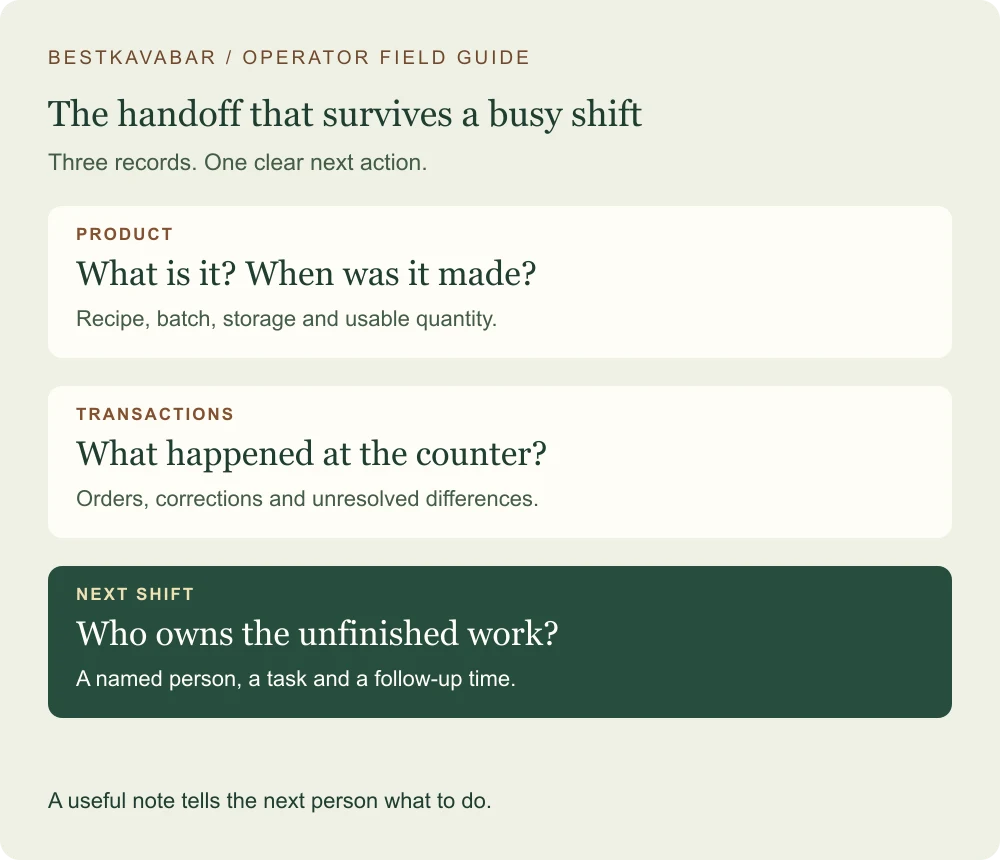
A close is complete when the next employee can open without detective work. Use named tasks and initials, not a single “all done” checkbox. Cleaning, product handling, money and guest incidents each need their own handoff.
| Area | Leave behind | Manager checks |
|---|---|---|
| Product | Identified batches, storage checks, waste and quantities needed. | No mystery containers or unexplained substitutions. |
| Station | Completed cleaning tasks and equipment issues. | The next employee can prepare an order safely. |
| Transactions | Closed tabs, refunds, discounts and reconciliation exceptions. | Differences have a note and an assigned follow-up. |
| Guests and team | Factual incident summary and unresolved action. | Private details stay in the appropriate restricted record. |
| Tomorrow | Event setup, shortages, maintenance and named owner for each task. | No urgent task exists only in somebody's memory. |
Write observations rather than gossip. “Guest disputed a charge; receipt reviewed; manager will call tomorrow” is actionable. A paragraph insulting the guest is not. Limit personal information to what the follow-up actually needs.
The shift lead reads the handoff before service, not after something goes wrong. Make that a visible part of the opening routine.
10. Assess the shift you expect them to run
Ask the trainee to prepare an approved batch, explain two menu options, handle an ingredient uncertainty, correct a ticket, welcome a solo guest, respond to a boundary problem and complete the handoff. Observe normal work and short scenarios; do not create a real emergency to test a reaction.
Some skills cannot be averaged away. An employee who still guesses about ingredients, skips required handling steps, or cannot get help during an incident needs more coaching before working without supervision. Excellent conversation does not cancel those gaps.
Use the printable assessment in the training kit. For each skill, write what happened, the level of help needed and the next practice task. Agree on a review date. “Needs improvement” without a next action is a dead end.
After approval, check again when recipes, equipment, menus or responsibilities change. Keep a short weekly team practice: one complaint scenario, one product update, or one handoff problem. Training that only exists during hiring slowly becomes folklore.
Questions owners and kavatenders ask
How long does kavatender training take?
Use seven supervised stages as a starting structure, then adjust to the menu and employee. Approval should follow demonstrated skills, not a fixed number of days. More complex preparation and service require more practice.
Does a kavatender need to drink kava?
They need accurate product knowledge and preparation skills. Consumption should not be required to prove competence. Ingredient identification, measured preparation and clear explanations can be assessed without drinking.
What should be in a kavatender handbook?
Current product cards, recipes, handling procedures, welcome scripts, transaction rules, house boundaries, escalation contacts, opening and closing checklists, and an observed skills assessment.
How do I train staff without making them sound scripted?
Teach the purpose of each interaction and practice a few examples. Let employees use natural language while keeping ingredient facts, prices, boundaries and escalation steps consistent.
Is this a kavatender certification?
No. It is an owner-run training and assessment framework. Record the training your employee actually completed and check any local requirements for their role separately.
Put it to work on the next shift
Choose one employee, one trainer and one skill to observe. Print the plan, put the current recipe cards at the station, and schedule the first debrief. Once the service is consistent, use the events playbook to give people a reason to return and the profitability guide to understand what the operation earns.