

1. Revenue, operating surplus and cash are different numbers
Kava bar profitability starts with a basic distinction: money collected is not all money earned, and money earned is not all money available. Sales tax and employee tips pass through the business. A gift-card sale brings cash before the associated visit. A loan brings cash without creating sales.
For operating decisions, begin with net sales after discounts and refunds, excluding tax and tips. Subtract the costs that move with those sales to find contribution. Then subtract the operating costs of keeping the bar open. This guide calls that result operating surplus before debt service, income tax and major equipment purchases.
It is a planning view, not a replacement for your accountant's financial statements. The useful question is whether the same costs appear once, in the right place, over the same period.
| Number | What it answers | What it does not answer |
|---|---|---|
| Net sales | What customers bought after discounts and refunds. | What the business keeps. |
| Contribution | What remains after the modeled sale-related costs. | Whether that amount covers the labor schedule and overhead. |
| Operating surplus | What remains after modeled operating costs. | Whether this week's cash covers debt principal or a new refrigerator. |
| Cash available | What can meet the next payments. | Whether the business earned a sustainable profit. |
The business-plan guide helps you build the opening model. This guide is for the owner who can now compare that model with real tickets, real waste and real payroll.
2. Cost the batch you can actually sell
Divide batch ingredient cost by saleable servings, not the servings you hoped to produce. Record the finished usable volume after the preparation process, then account for samples, remakes, spills and product discarded before sale. Do not subtract the same loss twice.
Use a consistent yield log for several normal batches. One unusually careful batch made while the owner watches is not a reliable operating assumption. Record the product and lot, recipe version, ingredient quantity, finished yield and disposition of any loss.
Worked example: ingredients cost $24. A batch produces 32 measured servings. Four servings are used for approved samples or lost before sale, leaving 28 paid servings. The ingredient cost recovered by each paid serving is $24 divided by 28, or about $0.86. Dividing by 32 would produce $0.75 and leave those four servings unfunded.
These are illustrative inputs, not a preparation recipe or an industry benchmark. Your product, recipe, vessel and measured losses determine your cost.
Packaging, mixers, garnish and optional ingredients belong beside that number. If a drink uses a disposable cup, lid and straw, record the set. If a flavor modifier adds cost, decide whether its price covers that cost rather than burying it in a vague average.
Put preparation labor in one place
You can cost preparation labor into each serving or keep all scheduled labor in the period's operating costs. Both can help planning, but combining them double-counts payroll. The calculator on this page keeps all scheduled labor, including preparation, in daily operating costs. Its per-order variable cost should therefore exclude that same payroll.
For a recipe comparison, temporarily measure minutes of preparation per batch and divide by usable servings. That helps compare methods. Transfer the result into the operating model only after removing the same labor from its other category. The kava-making equipment guide adds a useful capacity and labor test.

3. Price for contribution, not an impressive markup
Markup compares selling price with cost. Margin divides the amount left by sales. They are different percentages, and neither automatically includes every operating expense.
A $6 item with $2 in modeled variable costs contributes $4, a contribution margin of about 66.7%. The markup over that $2 cost is 200%. Calling the second figure “profit margin” would make an ordinary example sound like a financial miracle.
Payment fees also need the right unit. If a processor charges a percentage plus a fixed transaction fee, apply the fixed fee to the transaction, not to every item on a multi-item tab. Use the actual written pricing and check it against settlements. The calculator treats average order value as the full paid transaction.
Contribution per order = average net order value − variable product and packaging cost per order − percentage payment fee − fixed fee per order.
Use a weighted order mix. If half your orders contain multiple drinks or food, a single-shell calculation does not describe the business. Build the average from a representative period, then inspect the categories that differ most. A specialty drink may contribute more dollars while also taking much longer to prepare.
Make prices easy to understand
Show the serving size, what is included and what costs extra. A menu that relies on staff explaining surprise modifiers increases both service time and disputes. Compare your price with the experience and product you provide, not just the cheapest number on another bar's menu.
Test a price change with the item, date, old and new prices, units sold, contribution and complaints recorded. Avoid changing price, recipe, size and promotion at once; you will struggle to tell what customers responded to. Use the published menu-price snapshot for context, not as a prescribed price.
4. Turn the monthly bills into a daily target
The SBA's break-even framework divides fixed costs by the difference between selling price and variable cost. For a mixed-menu kava bar, use weighted average contribution per order and a clearly defined operating period.
For this page's simplified daily model, add scheduled daily labor and the daily share of other operating costs. Divide that total by contribution per order, then round up to a whole order. If contribution is zero or negative, no volume of those orders covers the operating costs.
| Illustrative daily input | Amount | Meaning |
|---|---|---|
| Average net order | $12.00 | After discounts, excluding tax and tips. |
| Variable product and packaging cost | $3.00 | For the average order, with expected loss included. |
| Payment fee assumption | 3% plus $0.15 | An example, not a processor quote. |
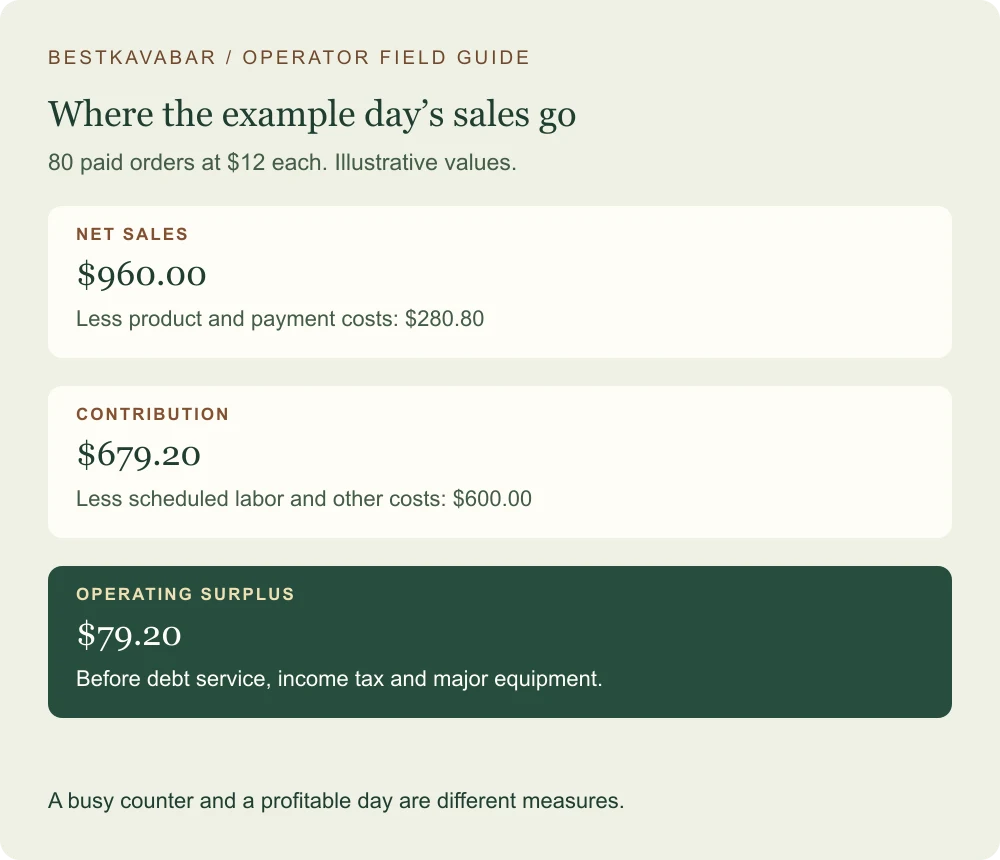
| Contribution per order | $8.49 | Twelve dollars less three dollars, thirty-six cents and fifteen cents. |
| Scheduled labor plus other costs | $600 | $360 labor and $240 other operating costs. |
| Break-even orders | 71 | Six hundred divided by $8.49, rounded up. |
| At 80 orders | $79.20 surplus | Eighty times $8.49, less $600. |
Convert monthly costs using a consistent method. If rent is allocated across trading days, divide by the days you actually plan to open that month. Keep the full monthly reconciliation as a separate check. A quiet Tuesday does not make one-thirtieth of the rent disappear.
The example holds labor and order mix constant. If another employee becomes necessary at higher volume, update labor before trusting the higher-sales scenario. A straight line in a calculator cannot see the queue at your counter.
5. Schedule labor around the work
Labor includes more than time standing at the register. Count preparation, opening, cleaning, receiving, training, management, payroll taxes and applicable employer costs. Owner shifts are work too. A bar that “makes money” only because the owner works without compensation has a different economics problem from a staffed business.
Map the week in service blocks. For each block, record orders, net sales, paid hours, preparation work and service problems. Compare similar weekdays over several weeks. A holiday, storm or unusual event can distort a single observation.
Do not cut a person just because the register is quiet while they prepare tomorrow's stock. Move preparation deliberately if a different block has spare capacity. Likewise, a busy block with repeated mistakes may need a simpler menu or better station layout rather than another permanent shift.
- Volume problem: too few orders for the scheduled hours.
- Workflow problem: enough demand, but preparation or payment creates a bottleneck.
- Training problem: repeated corrections and inconsistent methods consume time.
- Coverage problem: essential tasks have nobody assigned, even when overall staffing looks adequate.
Use the kavatender handbook to fix inconsistency before treating every slow shift as a staffing failure. The cheapest schedule on paper can become expensive through waste, weak service and an exhausted owner.
6. Make discounts earn their keep
A discount reduces contribution, not just the headline price. It can still be useful when it creates incremental business or a worthwhile return visit. The question is how much additional contribution it creates after the offer's costs.
Using the $12 example, a $2 discount brings the order to $10. With the same $3 product cost and the example fee structure, contribution becomes $6.55. That is $1.94 less per order because the percentage processing fee also falls slightly.
To preserve the contribution from 80 full-price orders, the discounted offer needs about 104 otherwise comparable orders: 80 multiplied by $8.49, divided by $6.55, rounded up. That comparison assumes no extra labor or offer expense. Add those costs when they change.
Also distinguish new demand from a discount handed to someone who would have purchased anyway. A promotion redeemed by existing Friday regulars may be generous without creating a single additional visit. Define the audience and the intended behavior before choosing the offer.
Give each test a start date, end date, cost cap, eligibility rule and review date. Ask whether guests return after the offer ends. The retention guide explains how to measure a complete return window instead of counting only quick responders.
7. Respect long stays while understanding capacity
Lingering is part of why people choose a kava bar. Treating every seated guest as a failed turnover metric can destroy the very reason they came. The economic question changes when the bar has empty seats versus when new guests cannot find a place.
During quiet hours, a guest reading with one drink may occupy capacity that would otherwise sit unused. During a consistently full event, a large group holding tables without participating may prevent other customers from joining. Observe the constraint before inventing a blanket rule.
Measure busy periods: occupied seats, waiting guests, abandoned visits, orders and service time. Consider layout, event reservations, quiet seating, optional food or non-kava drinks, and transparent booking terms. Offer choices that fit the visit; do not pressure people to consume more kava to justify a chair.
If you introduce a reservation charge or minimum for a specific event, make the terms visible before booking and explain what the payment buys. A surprise rule at the counter can cost more trust than the seat earns.
8. Find the leaks before buying more traffic
Track stock from receiving through use. Opening inventory plus purchases minus closing inventory gives a basic usage measure, provided the units and valuation method are consistent. Compare it with recipe-based expected usage and recorded waste.
A difference is a question, not proof of theft. It can come from counting errors, unit conversions, inconsistent serving sizes, unrecorded samples, remakes, purchasing dates or recipe substitutions. Investigate the process before accusing a person.
| Signal | Check first | Small test |
|---|---|---|
| Product cost rises | Supplier price, recipe, usable yield, waste and sales mix. | Log every batch and loss for one normal week. |
| Sales rise but cash shrinks | Inventory buys, taxes, payroll timing, debt and owner draws. | Build a dated cash-payment calendar. |
| Busy shifts earn little | Discount mix, staffing, remakes and event expenses. | Compare contribution with similar non-event shifts. |
| Good unit margin, weak total result | Order count and the full operating-cost base. | Model realistic volume before adding advertising spend. |
Keep purchasing tied to expected use and lead time. A bulk discount is not a saving if cash gets trapped in stock that will not be sold in usable condition. The wholesale supplier guide includes receiving and supplier checks that support this work.
9. Keep a cash calendar beside the profit model
Put the next thirteen weeks on one sheet. Start with available cash, add expected cash receipts and subtract payments on their due dates. Separate payroll, taxes, rent, suppliers, debt principal and interest, equipment, and owner draws. Update it weekly with actuals.
Do not count the same receipt twice when a gift card is sold and later redeemed. Do not treat collected sales tax as spending money. Discuss how those items are recorded with the person maintaining your books, then make the operating sheet follow the same definitions.
A profitable month can still contain a cash shortage when several bills arrive together. Seeing it in advance gives you time to change purchasing, scheduling or discretionary spending. A revenue forecast without payment dates cannot show that collision.
Keep an explicit owner-compensation assumption. If your model includes a replacement wage for the owner's operating work, distinguish that planning cost from actual draws and tax treatment. Otherwise, comparing this month with last month can become a comparison of how much unpaid work the owner absorbed.
10. Run a weekly review that leads to one decision
Choose a fixed day and review a small set of numbers: orders, net sales, average order, product usage, waste, paid labor, contribution, operating result and upcoming cash commitments. Reconcile mismatches before building an elaborate dashboard on top of them.
Write one sentence explaining the largest change. Then choose one test with an owner and a review date. “Reduce waste” is too vague. “Measure the last batch on the three slowest evenings and compare discarded servings next Friday” is a task.
Use a four-week improvement cycle: week one establishes consistent records; week two tests the biggest product or workflow leak; week three reviews one price or offer; week four compares the result and decides what to retain. Keep the test small enough that you can explain what changed.
When the numbers show that demand is the constraint, use the new-market playbook. When a specific evening needs a reason to visit, use the events playbook. Marketing becomes easier to judge once you know what an additional order is worth.
Questions owners ask about profitability
What is a good profit margin for a kava bar?
A useful target depends on rent, staffing, menu, owner compensation and financing. Start with your actual costs and required return. This guide does not claim a verified industry-wide profit margin.
How many orders does a kava bar need to break even?
Divide the period's modeled operating costs by contribution per order and round up. Recalculate when labor, prices, costs or order mix change. Zero or negative contribution cannot cover positive operating costs.
Should preparation labor be included in drink cost?
It can be included for recipe analysis, but count it only once in the whole-business model. This page's calculator keeps scheduled preparation labor in daily labor costs, outside variable product cost.
Why can a busy kava bar still lose money?
Low contribution, heavy discounts, waste, expensive staffing or a large fixed-cost base can consume the sales. Busy seats also do not necessarily mean many paid orders. Compare the actual order mix and costs.
Does the calculator predict my take-home pay?
No. It estimates contribution, break-even orders and operating surplus from your inputs. Debt service, income tax, equipment spending and the timing of cash receipts and payments need a separate cash plan.
Make one number trustworthy today
Take a normal week's paid orders and calculate the actual average net transaction. Measure one batch's usable yield. Enter the labor you really scheduled. Those three observations make a stronger starting point than a confident claim that kava has amazing margins.