
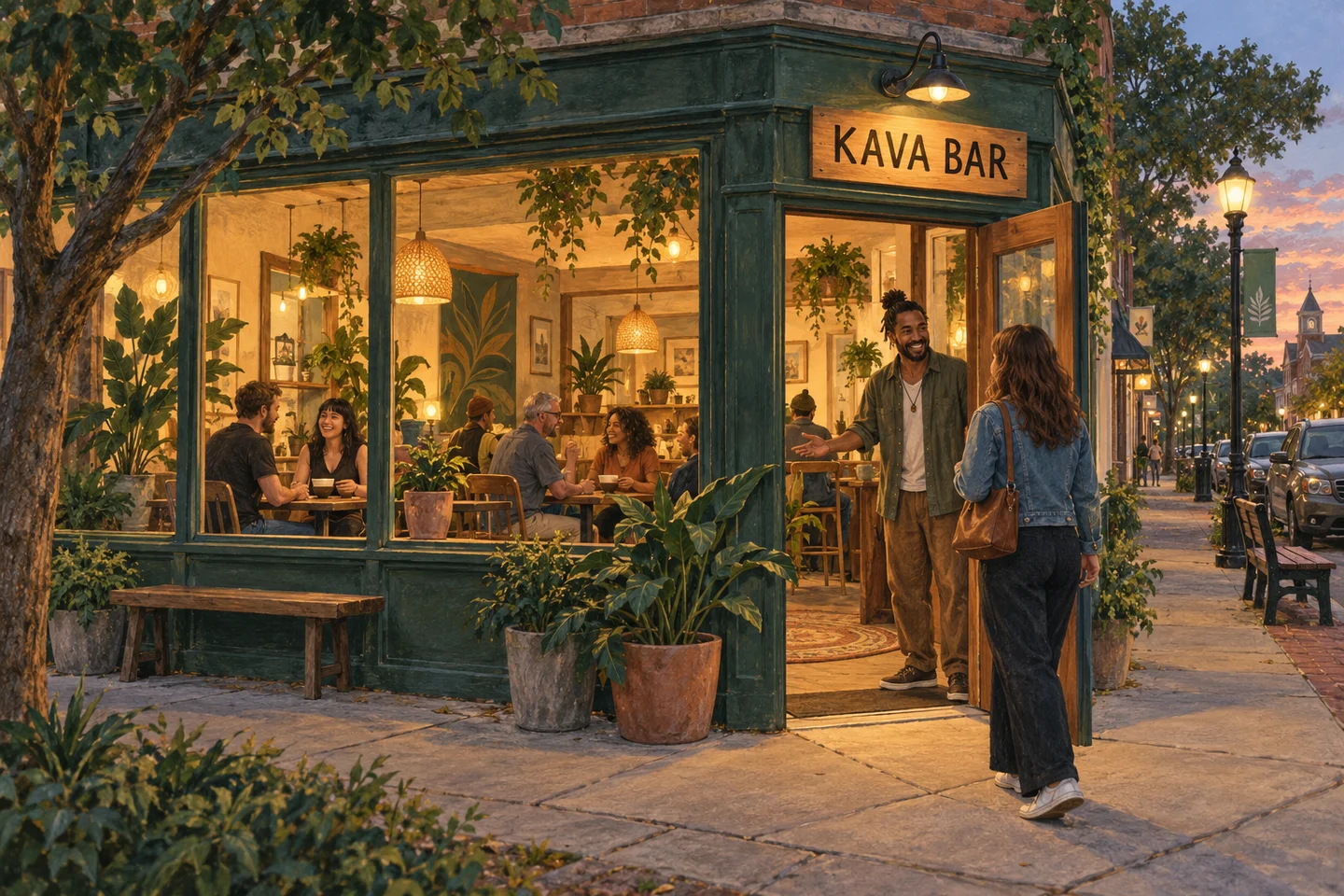
That is the job before you can depend on people searching for “kava near me.”
If you are opening the first kava bar in town, you are introducing two unfamiliar things at once: a drink and a kind of place. A photo of a shell and a grand-opening flyer may mean something to an experienced kava drinker. To your neighbor, they may explain almost nothing.
The neighbor still has a social life. They still want somewhere to go. Your opportunity is to connect your unfamiliar business to a familiar need.
You do not need the entire city to become interested in kava. You need enough nearby people to understand your kava bar, choose a first visit, and find a reason to return.
The risk is mistaking an empty category for proven demand. Having no competing kava bars does not establish that enough people will buy what you serve, at your prices, often enough to support the business. Test that locally before making the marketing budget bigger.
This guide is for owners opening in an unfamiliar market and operators whose existing kava bar still attracts mostly people who already know kava. It also applies in established markets: a neighborhood can have several kava bars and plenty of residents who have never walked into one.
The plan at a glance
Build the first version around one nearby audience, one recurring occasion, and one clear invitation.
| Work to do | What it should produce |
|---|---|
| Learn how locals actually spend their free time | A specific occasion your kava bar can serve |
| Explain the business in ordinary language | A stranger can say what happens there and why they might go |
| Make a first visit easy to picture | Real prices, an entrance photo, clear hours, and a simple ordering path |
| Work with people who already gather your audience | A relevant introduction attached to a real date |
| Run a repeatable experience | A second invitation ready before the first event starts |
| Measure new customers and return visits | Evidence about what deserves the next dollar |
Before opening: start with the local research and paid-pilot sections. Already open but quiet: check your message, first-visit page, and partnerships. Getting first visits without growth: use the economics and diagnosis sections, then the companion guide to turning kava first-timers into regulars.
01 Understand what you are asking people to change
An experienced kava drinker may compare your hours, location, products, and atmosphere with another kava bar. An unfamiliar customer has earlier questions.
What is this place? What do people do there? Will I feel awkward? What will it cost? Can my friend come if they do not want kava?
Your marketing has to answer those questions before a cultivar announcement or loyalty offer becomes useful.
Separate interest in the drink from interest in the visit
Someone can be curious about kava and never become a customer. They might live an hour away, prefer drinking at home, or enjoy reading about unfamiliar products without buying them.
Someone else may have little interest in kava education but want a place to play a board game with friends on Wednesday. That person can become a paying customer who learns about kava over time.
Track both:
- Category interest: questions, explainer views, and curiosity about kava.
- Local visit interest: menu views, event inquiries, attendance, purchases, and return visits.
The first can help generate the second. They are not interchangeable.
Your alternatives include the couch
Look beyond other kava bars. Customers might choose a coffee shop, a restaurant, a brewery, a game store, a park, a friend's home, or another evening watching television.
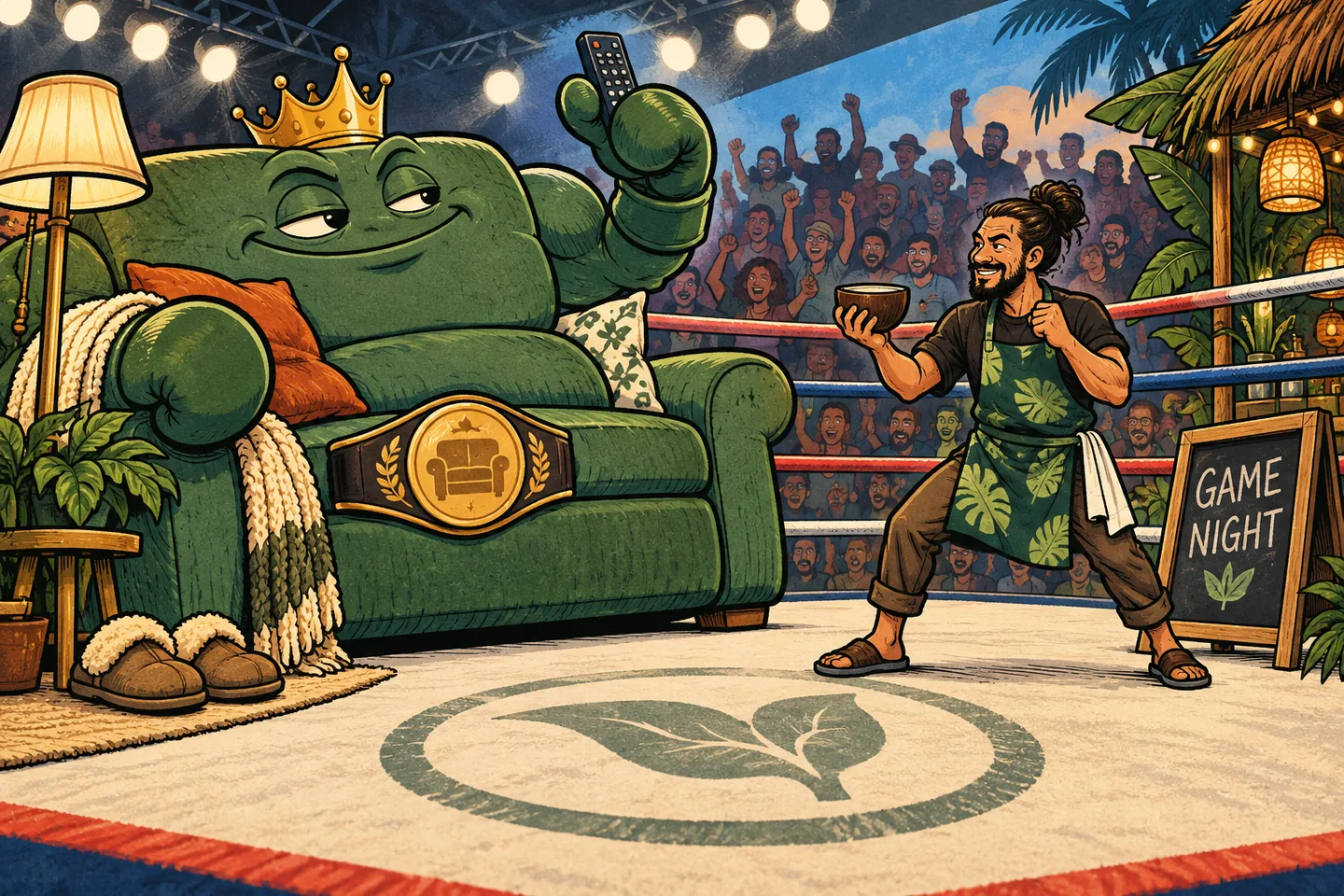
Ask what your kava bar makes easier. A late café visit? A conversation without shouting? Meeting people after moving to town? Spending time with friends whose drink preferences differ?
Do not build the entire pitch around persuading alcohol drinkers to abandon alcohol. Invite people to a specific occasion they can enjoy without it. Someone can choose your kava bar on Thursday and a different kind of venue on Saturday.
Local familiarity matters more than the state label
“We are in Florida” is not a customer-awareness study. Neither is “we are the first in the state.” Research the people who can realistically visit your address.
An established kava audience nearby can reduce the amount of explanation some customers need. It does not remove the opportunity to introduce new people. Keep an easy beginner path even after you have regulars who know every item on the menu.
02 Find the local occasion before choosing the campaign
Start with a catchment you can serve repeatedly. In a walkable neighborhood, that may mean nearby streets and transit stops. In a smaller town, it may mean practical driving routes, parking, and the times people already travel into town.
A statewide population figure tells you little about who will visit on an ordinary Tuesday.
Conduct a small round of useful conversations
Start with 15 to 20 conversations across two or three plausible groups. This is an exploratory work target, not a representative survey. Include people outside your friends, existing followers, and kava circles.
Use questions about things they have already done:
- Where did you go the last time you wanted to spend time with people without drinking alcohol?
- What worked about that visit, and what was missing?
- Who were you with, what time was it, and how far did you travel?
- What did you spend, including food, drinks, transport, or admission?
- How did you hear about that place?
- What would make you decide against trying somewhere new?
Only then show a plain description of your concept. Ask them to explain it back and identify what they would need to know before visiting.
“Would you come to my amazing new kava bar?” mostly tests politeness. A description of last Thursday gives you something to work with.
Keep notes on occasions, obstacles, schedules, and spending. You do not need anyone's medical history or an explanation of why they avoid alcohol.
Choose an audience you can actually reach
| Possible audience | Occasion to test | Evidence to look for |
|---|---|---|
| Adults new to the area | A hosted evening where arriving alone is normal | They already attend local newcomer activities and want another dependable place |
| Existing hobby groups | A regular place for games, drawing, reading, or conversation | An organizer has members, a recurring schedule, and a venue problem |
| Friends with different drinking preferences | An evening everyone can participate in | The group currently compromises on where to go |
| People looking for an evening café | Somewhere open after nearby cafés close | The time gap exists and customers will pay for your actual menu |
| Nearby workers | A convenient gathering at a particular shift change | Their schedules, travel routes, and spending fit your service hours |
Choose the best-supported starting point. Avoid inventing a customer from a collection of fashionable labels.
For example, “wellness-minded millennials” gives the team little to do. “The adult drawing group that meets two blocks away and needs a place afterward” gives you a person to contact, a time to staff, and a visit to test.
Use a paid pilot to test the promise
Where your operation is authorized to serve, run a small event or temporary service that resembles the business you intend to operate. Set a clear price and include a real route back to another session.
Record attendance, purchasing, the questions guests ask, how much staff explanation is needed, and who returns. Separate friends and family from people who discovered you through the test.
A free tasting tells you something about curiosity. A paid visit followed by another paid visit tells you more about demand. Neither proves a full lease will work by itself.
Before announcing a pop-up or sampling event, confirm the approval requirements for the location, preparation, and exact products. Another venue's permission to sell drinks is not proof that it covers your service. Use the kava bar opening guide for the wider opening sequence.
Write down what would make you revise the offer, audience, hours, or location. If every result leads to “spend more,” you have not designed a useful test.
03 Give people language they can understand and repeat
Describe the place, explain the drink, and offer a visit. That order helps a newcomer connect the unfamiliar ingredient to something they might want to do.
Keep “kava bar” visible. Familiar language should explain the business without concealing what you serve.
The message has three jobs
The place: what can someone do here?
An alcohol-free place in [neighborhood] to meet friends and spend the evening.
The drink: what is kava?
Kava is a drink made from the root of a Pacific Island plant. We serve [accurate description of your preparation], with staff available to explain the menu.
The invitation: why visit now?
New here? Join our hosted game night on [day] at [time]. You can come alone, and we will help you find a table.
Only use promises your actual operation supports. An alcohol-free claim must match the venue and menu. A hosted event needs a host. A solo-friendly night needs someone who notices solo arrivals.

Match the promise to the audience
For people seeking a late café, show your real evening hours, seating, lighting, and menu. For a hobby group, explain the table arrangement and how long the activity runs. For a date, show what two people can do and what their first order might cost.
Do not squeeze all of those messages into one flyer. Give each campaign a recognizable occasion.
The phrase “third place” is useful when planning the business: somewhere beyond home and work where people can spend time and build relationships. In an ad, “a place to meet friends after dinner” may communicate the actual offer more quickly.
Test the explanation on a stranger
Show your homepage, window sign, or event flyer to a few local adults unfamiliar with kava. Give them a brief look, then ask:
- What kind of business is this?
- What would you do there?
- What would you want to know before going?
- What is the next step?
If they think it is a supplement shop, an alcohol bar, or a members-only club, fix the message before buying more attention.
Listen to the language they use. A customer saying “the place where we can actually hear each other” may give you a clearer direction than another paragraph about your brand philosophy.
04 Teach enough to help someone make a choice
Education should answer the question in front of the customer. A person deciding whether to walk through the door needs a different amount of detail from someone asking about sourcing.
Build three layers: a short introduction, a clear ordering explanation, and a deeper resource for people who want it.
A short introduction for staff
Adapt this to your products and venue:
“Welcome. Kava is a drink made from the root of a Pacific Island plant. Ours has an earthy taste, and we can explain how we prepare it. You are welcome to ask questions before ordering. We also have [actual non-kava options] if you would prefer something else.”
Then ask a useful question: “Would you like a quick menu explanation, or are you here for the event?”
The introduction opens a conversation. It does not replace ingredient information or the product guidance a guest needs before deciding to consume kava.
Make the menu do some of the teaching
Give a newcomer a small set of understandable starting choices. Name the ingredients, describe the taste, show the price and serving format, and make the distinction between kava and other drinks visible.
If your menu also includes kratom or other botanicals, identify them plainly. A customer should not have to decode a branded drink name to find out what plant they are ordering. Keep ordinary non-kava options easy to find.
Explain “shell” if you use it as a serving term. Spell out what a “traditional” preparation means at your bar. A photo helps with the vessel; a sentence helps with the product.
Make trust part of the explanation
An alcohol-free venue can welcome people who cannot or do not want to drink alcohol. That does not establish that kava is appropriate for each of them.
Kava can cause dizziness and other adverse effects, and rare serious liver injuries have been reported, including with water-prepared beverages. It should not be combined with alcohol or sedatives. People taking medicines, with liver concerns, or who are pregnant or breastfeeding need qualified health guidance before use; staff should not provide individual medical clearance. NCCIH explains the evidence and safety concerns.
Build the pitch around the experience you can deliver. Claims such as “treats anxiety,” “safe for everyone,” or “hangover-proof” promise outcomes the venue cannot establish. Health-related advertising needs appropriate evidence, including for implied claims. FTC guidance on health product claims.
Make choosing a non-kava drink comfortable. Do not make stronger effects or additional consumption the measure of a successful first visit. Nobody needs to prove that they belong by finishing a shell.
Give Pacific origins real space
Kava comes from the Pacific, with longstanding cultural uses that predate the modern U.S. kava bar. NCCIH's kava background provides a starting reference.
Learn the origin of the kava you sell. Tell that story accurately. If you invite Pacific cultural educators or community members to contribute, agree on the role and pay them for their work. Avoid presenting a U.S. marketing event as an authentic ceremony you are not qualified to lead.
For customers who want more than the short introduction, link to what kava is and what a kava bar is. Keep the next practical step visible: read the menu, see the event, or plan a visit.
05 Build a first visit someone can picture
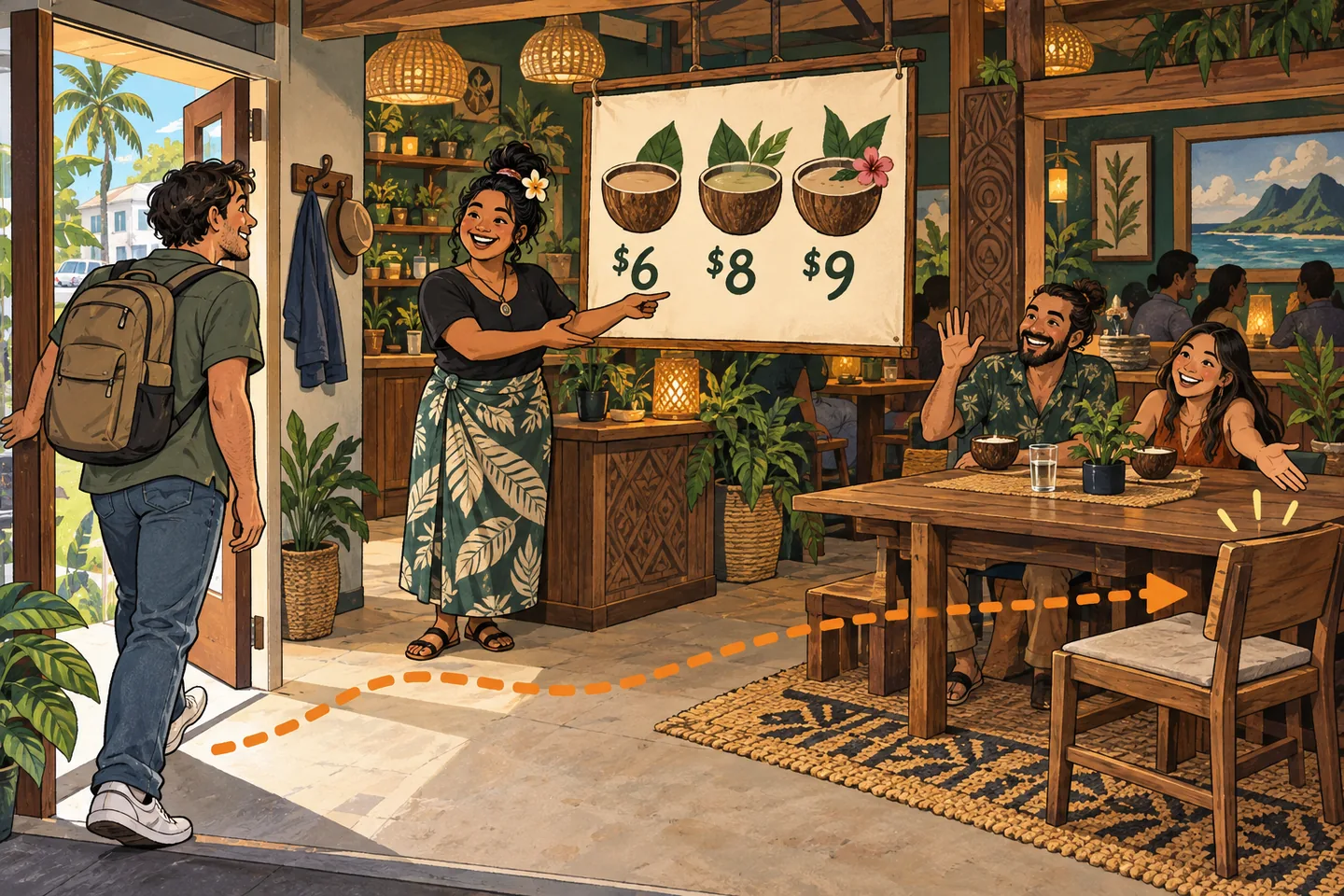
An unfamiliar concept creates enough uncertainty on its own. Do not add missing prices, an unmarked entrance, or an event post with no start time.
Make one first-visit page the destination for your flyers, partner links, local posts, and event invitations. A newcomer should be able to answer these questions without downloading an app or sending a message:
- What happens at this kava bar, and what drinks are available?
- What can I order, what does it cost, and is there a cover or purchase requirement?
- Can I come alone or choose a non-kava drink?
- What is the age policy?
- When are you open, and when does the advertised activity begin and end?
- Where is the entrance, and what are the parking, transit, and accessibility details?
- Do I need to book, or can I walk in?
Use real photos of the exterior, counter, seating, and ordinary service. Include an image that makes arriving alone easier to imagine. An extreme close-up of a drink cannot explain the whole visit.
Make the physical entrance agree
Walk toward your business from the direction a first-time visitor would arrive. Can you identify the door? Can you tell that it is open? Can you understand what is sold without already knowing the word kava?
A small window message can do useful work:
Kava bar and alcohol-free social space. New here? Ask us for a quick introduction. Menu and prices inside.
Use a different description if that does not accurately match your business. Put basic information in visible text as well as behind a QR code.
Once people start hearing about you, make the lookup easy. Keep your business name, hours, address, menu, and photos consistent on your own site, maps, and relevant directories. Google says complete, accurate business information supports local visibility; results also depend on factors including relevance and distance. Google Business Profile guidance.
The general kava bar marketing guide covers the wider channel setup. The priority here is removing uncertainty for someone who is still learning what the business is.
06 Borrow an introduction from people who already gather your audience
A local organizer can explain why your kava bar belongs in someone's week more credibly than an unfamiliar business can explain it alone. The partnership has to solve something for that organizer.
Look for a genuine match between the group's activity and your capacity. An adult book group may need predictable seating. A drawing club may need good light. A neighboring business may want somewhere to send customers after its evening class.
Choose partners by behavior
Build a short list of local organizers and businesses. For each, record the actual audience, typical gathering time, venue needs, and person who makes decisions.
Then ask:
- Are their participants close enough to return independently?
- Does their activity fit our atmosphere, hours, and age policy?
- Can we provide something useful without making the event a sales presentation?
- Will the organizer help explain the visit and distribute the invitation?
- Can this become a recurring arrangement if the first test works?
An account with a large following and few local attendees is a weak fit for a neighborhood habit. A small organizer with an active local group may be worth much more to your specific test.

Do not assume a fitness group wants a botanical drink recommendation or that a recovery community endorses kava. Offer a venue and a choice of clearly identified drinks. Let organizers decide whether the setting fits their members.
A partnership message you can adapt
Hi [name], I saw that [group] meets for [specific activity]. We run [bar] in [neighborhood] and could host a small [activity] evening on [date]. We can provide [specific seating or hosting support], and your members can choose from [accurate drink options]. Kava is optional. Here are the menu, prices, age policy, and access details: [link]. Would a short visit help you decide whether the space works for the group?
Personalize the reason for the approach. A hundred copies of “let's collaborate” create a hundred small chores for other people.
Agree on attendance limits, costs, who welcomes guests, who promotes the event, and the next date. If you are paying the host, say what the payment covers. Organizers should not discover at checkout that you expected them to guarantee a minimum spend.
Give the partner a finished invitation
Send a small, useful package: a short description, one accurate photo, a direct event link, price and age details, and the explanation of what happens when someone arrives alone.
Use a distinct event link or a simple source label so staff can recognize the visit. Keep the tracking lightweight. The organizer is helping host an activity, not implementing your marketing software.
Afterward, share the results relevant to them: attendance, participant feedback, operational issues, and a concrete proposal for the next session. Do not send a report full of impressions when their concern is whether people enjoyed the evening.
07 Give education a social setting
A standalone lecture about an unfamiliar drink asks people to become interested before they arrive. An accessible activity gives them a reason to visit while they learn.
Start with one recurring event that fits your chosen audience. Keep the day and time stable long enough to learn whether people can make it part of their routine.
Three formats worth testing
| Format | What makes it accessible | What to measure |
|---|---|---|
| Hosted introduction and conversation | Staff explain the menu; guests can choose kava or another drink; introductions are optional | Purchases, unanswered questions, and return visits |
| Beginner game or creative night | The activity is explained, solo guests have a place to join, and equipment needs are clear | New local attendees who return when the original partner is absent |
| A recurring neighborhood gathering | Same host, time, and purpose; newcomers know how to participate | Attendance across several sessions and whether the event pays for its extra work |
Choose an activity you can execute well. Five inconsistent events can make the calendar look busier while making the experience less dependable.
A sample 75 minute newcomer event
This is an operating template, not a required format or a consumption schedule.
Before arrival: publish prices, access details, age policy, and whether booking is needed. Prepare a clear non-kava choice. Brief every staff member on the promise and name one host.
Minutes 0 to 15: welcome arrivals, explain ordering, and help solo guests find a comfortable place. Keep the counter from becoming an unexpected classroom queue.
Minutes 15 to 25: offer a brief introduction to the product and the bar. Explain what is on the menu and invite questions. People can listen without ordering kava.
Minutes 25 to 60: run the activity. Let guests choose how much conversation they want. The host notices people who need help joining in and leaves people alone when that is their preference.
Minutes 60 to 75: mention the next relevant date and invite practical feedback. Show how to find the calendar or voluntarily subscribe to updates.
The event should still be worth attending for someone who chooses a non-kava drink. That makes it easier for friends with different preferences to visit together.
Design for a quiet opening night
Pick an activity that works with four people as well as twenty. Arrange seating for actual attendance and have a host prepared to participate. If there are too few people for a tournament, switch to a casual game without pretending a crowd is about to arrive.
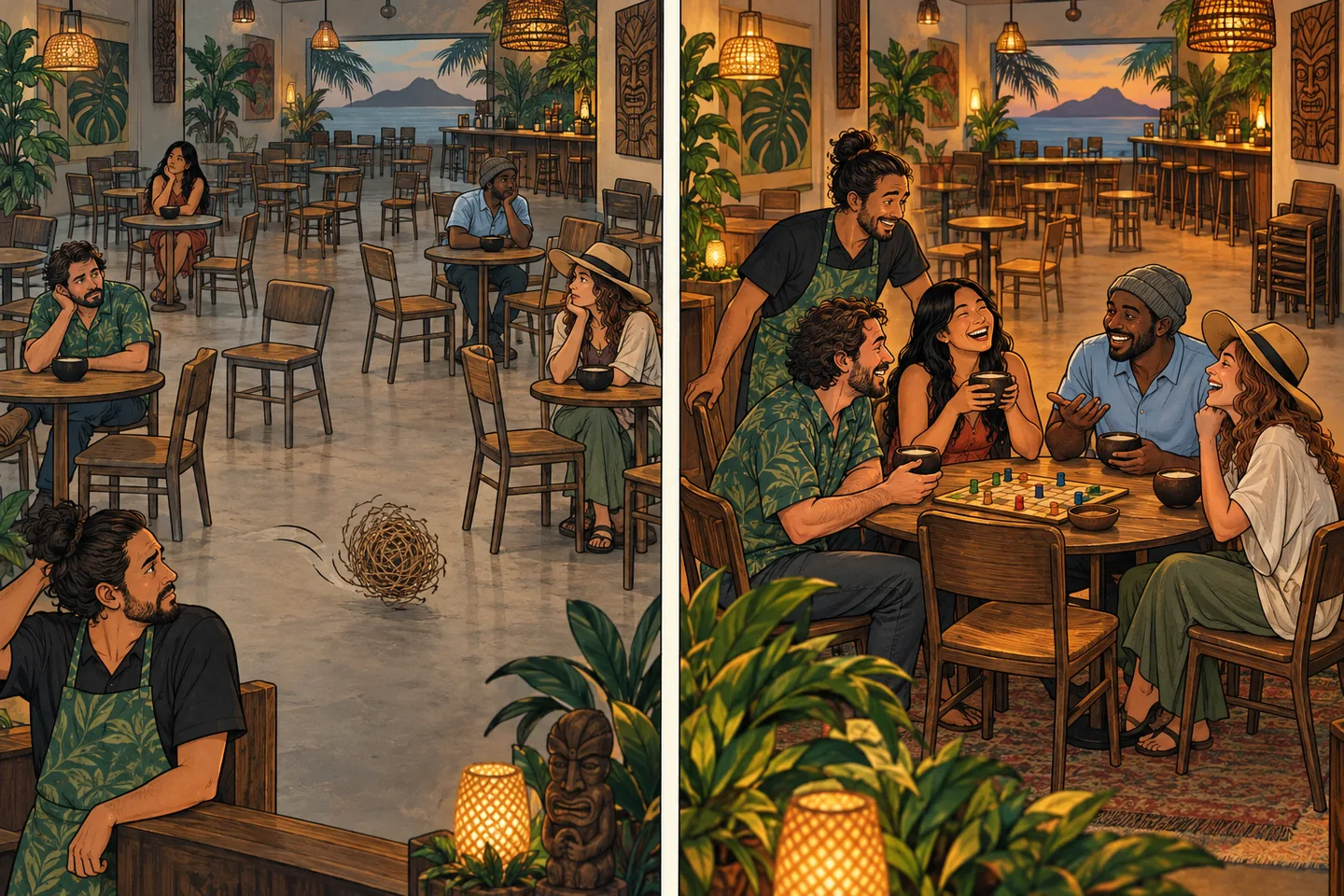
Do not advertise a lively social night and leave the first guest alone with an employee scrolling behind the counter. Early attendance is part of the product you have to host.
Put a sensible booking cap on any introduction that needs staff time. A first-time guest can require more explanation than a regular; your opening capacity is the number of people you can welcome properly, not just the number of chairs.
Make sampling lead somewhere
At an authorized off-site event, explain the product before offering a sample. Provide ingredient information, make declining easy, and attach the introduction to a real next visit.
A useful card says what the kava bar is, where it is, and what is happening on a specific date. Include a short readable web address as well as a QR code.
Count conversations, scans, subsequent visits, and return visits separately. A hundred accepted samples are not a hundred acquired customers. The test ends at the business outcome, not when the cups run out.
08 Make content answer the next unanswered question
Your first local audience needs to see what the place is like and how a visit works. Give them that evidence before filling the feed with drink names and announcements they cannot interpret.
Build content around the questions you keep hearing. One clear answer can become a short video, a page section, a printed card, and a staff explanation.
A practical content bank
| Customer question | Useful content |
|---|---|
| What is a kava bar? | A short tour showing the entrance, ordering, seating, and what guests do |
| Do I have to know anything about kava? | A staff member demonstrating the beginner explanation |
| What will it cost? | A real first-order example with current prices and any extra charges |
| Can I come by myself? | The host showing where to check in and how joining an activity works |
| What if I do not want kava? | The actual non-kava choices, with ingredients and prices |
| What does it taste like? | A straightforward description of the preparation you serve |
| What happens on a normal evening? | An honest view of an ordinary shift, filmed with guests' agreement |
| Why go this week? | One event with a clear audience, start time, price, and next step |
| Where is the entrance? | A walk from the parking or transit arrival point to the door |
| Can I bring my friends? | Seating, group-size guidance, and choices for different preferences |
You do not have to publish all ten in a week. Build the missing explanations first, then keep them current.
Let the first frame make sense locally
For a short video, begin with the familiar occasion: “Looking for somewhere to go after dinner in [town]?” Show the actual venue immediately. Explain that it is a kava bar and what that means, then give one invitation.
Keep captions readable. Show the location, time, and price where someone can find them without hunting through comments. Use a description that matches the landing page and the staff's understanding of the event.
Avoid a montage that looks like every other nightlife advertisement. In an unfamiliar market, clarity itself does useful marketing work.
Give local media a local story
An editor needs more than “we opened a business.” Explain what residents can now do that was difficult before, and make the claim specific.
[Bar] is opening an alcohol-free evening gathering place in [neighborhood], with [actual programming] and a menu that includes kava and [actual alternatives]. The owner can explain the concept and show how a first visit works. The opening event is [date, time, access details].
Use “first in the city” only after checking it. The social occasion can be interesting without a superlative.
For local creators, choose an audience match and a useful assignment: show a first visit, explain the prices, or attend a real event. Agree on deliverables and paid usage rights. Paid or gifted endorsements need clear disclosure of the relationship. FTC disclosure guidance.
09 Match each channel to the job it can do
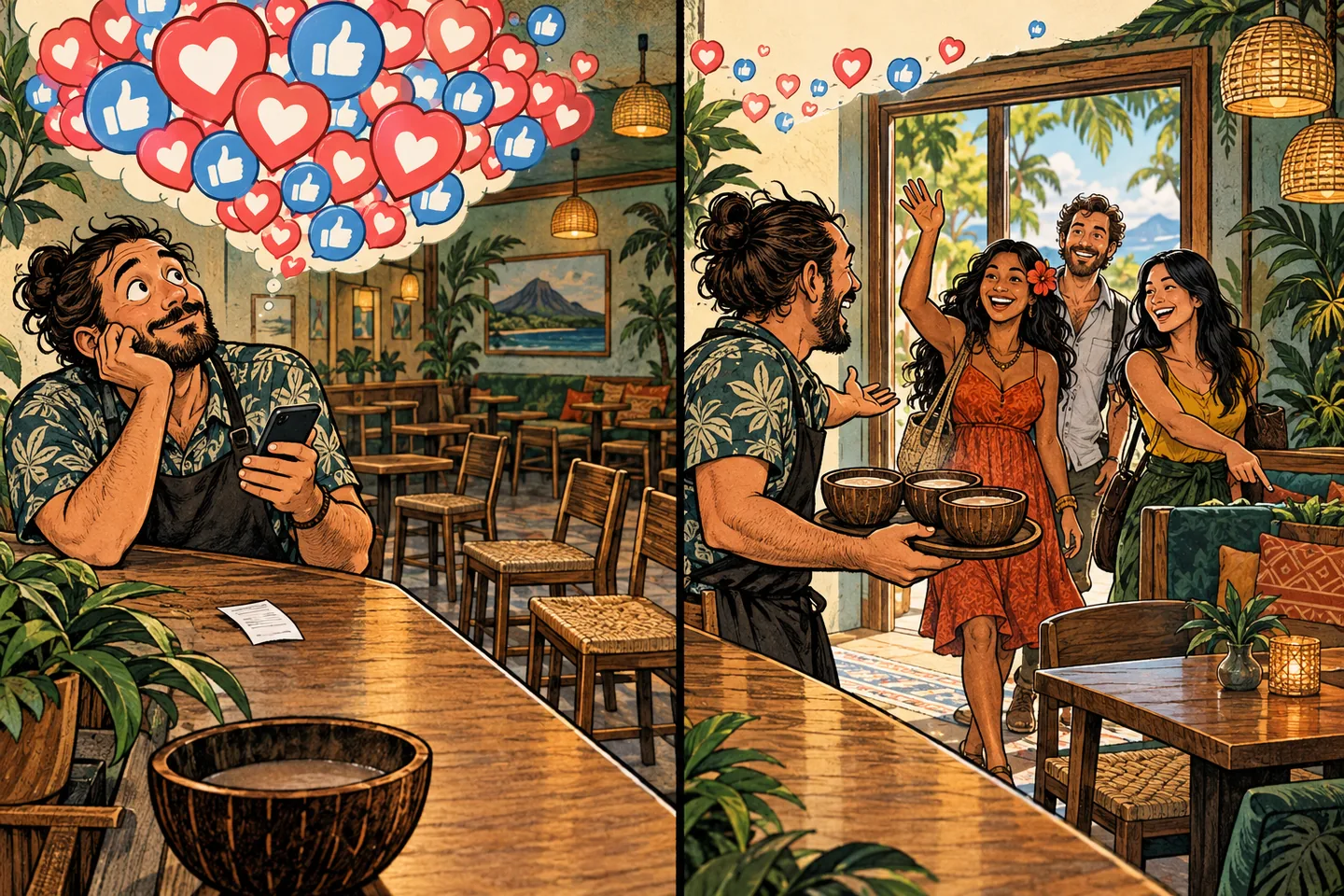
Search helps when someone has a question or an occasion in mind. Local partnerships and social distribution can introduce an idea before someone knows what to search for. Your plan needs both discovery and a clear destination once curiosity exists.
Keep category search and occasion search separate
Maintain accurate information for people who already search for kava. Also create useful content around real occasions your bar serves, such as evening cafés, alcohol-free outings, or beginner game nights in your town.
An occasion page must deliver the promise. If you describe a late-night option, show hours that support it. If you describe a game night, give the current schedule and how to participate.
Do not create dozens of near-identical city pages for places you cannot conveniently serve. One useful local page with an actual event can do more for a customer than a pile of town names.
Give paid promotion a bounded test
Begin after the invitation works in conversation and the first-visit page answers the practical questions. Use a small budget you can afford to lose while learning.
Set the audience to a realistic travel area and the applicable adult age range. Use location and occasion; avoid trying to infer sensitive reasons someone might avoid alcohol.
Test one meaningful difference at a time. For example, compare an invitation to a hosted social evening with an invitation to a beginner activity, while keeping geography, spending, and measurement comparable. If each ad leads to a different experience, judge the whole invitation, not just the headline.
Write the stop rule before launch: spending limit, review date, and the number or cost of qualified first visits that would justify another test. Small samples are directional; a single good night is not a reliable forecast.
Check the platform's current rules for the products, audience, and destination before spending. An event angle still needs to describe the actual business honestly.
Measure the handoff between channels
A customer might see a partner's post, search your name, read your menu, and finally come with a friend. The last click does not tell the whole story.
Ask “How did you first hear about us?” and, when the conversation permits, “What made you choose today?” Record a primary source and an optional assisting source. Do not count one customer as three acquisitions because three channels helped.
Keep your HappyKava public listing current for people already exploring kava bars. It supports discovery and visit planning; local education still has to reach residents outside the existing kava audience.
10 Turn the first visit into a recognizable next occasion
Market creation is expensive if every customer has to be found, taught, and persuaded from the beginning every time. Give a useful first experience a clear continuation.
Prepare the next invitation before running the first event.
Replace a vague goodbye with a relevant invitation
“Come back sometime” gives the guest another decision to solve. “The drawing group meets here next Wednesday at seven; the host welcomes new people at the front table” describes an actual visit.
Match the invitation to what the guest liked. Someone who wanted a quiet conversation may not want your biggest music night. Someone who liked the game may want another beginner session before joining the advanced group.
Make the ordinary week dependable too. If a partner event is welcoming but the bar feels closed to outsiders the following night, the event cannot carry retention by itself.
Give regulars a useful role
Invite willing regulars to help newcomers understand the activity or find a seat. Keep staff responsible for hospitality and product information.
Watch for inside jokes, unexplained rituals, and tables that function like reserved territory without being marked that way. Familiarity is valuable when it helps new people participate. It becomes a barrier when a newcomer feels they walked into someone else's private party.
Praise helpful hosting, not how much anyone consumes. A customer who returns for a non-kava drink and brings friends is participating in the business you are trying to build.
Follow up with permission and a reason
Offer an optional subscription to the calendar or specific event series. Tell people what they will receive and use an appropriate opt-in process for the channel. Keep a purchase or event registration separate from agreeing to marketing.
A useful follow-up is short:
Thanks for joining [event] at [bar]. Our next [activity] is [day and time], with [one useful detail]. Here are the menu and event details: [link]. If anything about the first visit was unclear, you can reply here.
Include the unsubscribe mechanism required by your sending system and applicable rules. Do not import a partner's member list as your own mailing list.
For the full arrival, ordering, staff, and second-visit experience, use How to Turn More Kava First-Timers into Kava Bar Regulars. This guide gets the unfamiliar local audience to that first visit; the companion helps make it worth repeating.
11 Put a price on creating a customer
Education takes time. Hosts cost money. Complimentary products have a cost even when nobody rings up a sale. Count that work when deciding which marketing you can afford to repeat.
Separate the money needed to open and operate the business from the smaller budget used to test demand. Your kava bar business plan should carry the lease, labor, cash runway, and wider operating assumptions.
An illustrative small test budget
The following is a $1,200 planning example for one acquisition cycle. These are invented inputs for demonstrating the calculation, not recommended market rates or industry benchmarks.
| Test expense | Example amount |
|---|---|
| Extra event staffing | $200 |
| Simple photos and first-visit materials | $150 |
| Printed invitations and signs | $100 |
| Host fees, event supplies, and complimentary products | $200 |
| Local paid distribution | $250 |
| Owner time valued for comparison | $300 |
| Total economic cost | $1,200 |
Cash spending in this example is $900; the additional $300 recognizes owner time. Track both. A plan that works only because the owner contributes unlimited unpaid hours may be difficult to sustain.
If money is tighter, reduce the number of experiments. Use existing photography, one partner, one event, and a modest print run. Protect the quality of the visit before paying to distribute it more widely.
Calculate acquisition and observed contribution separately
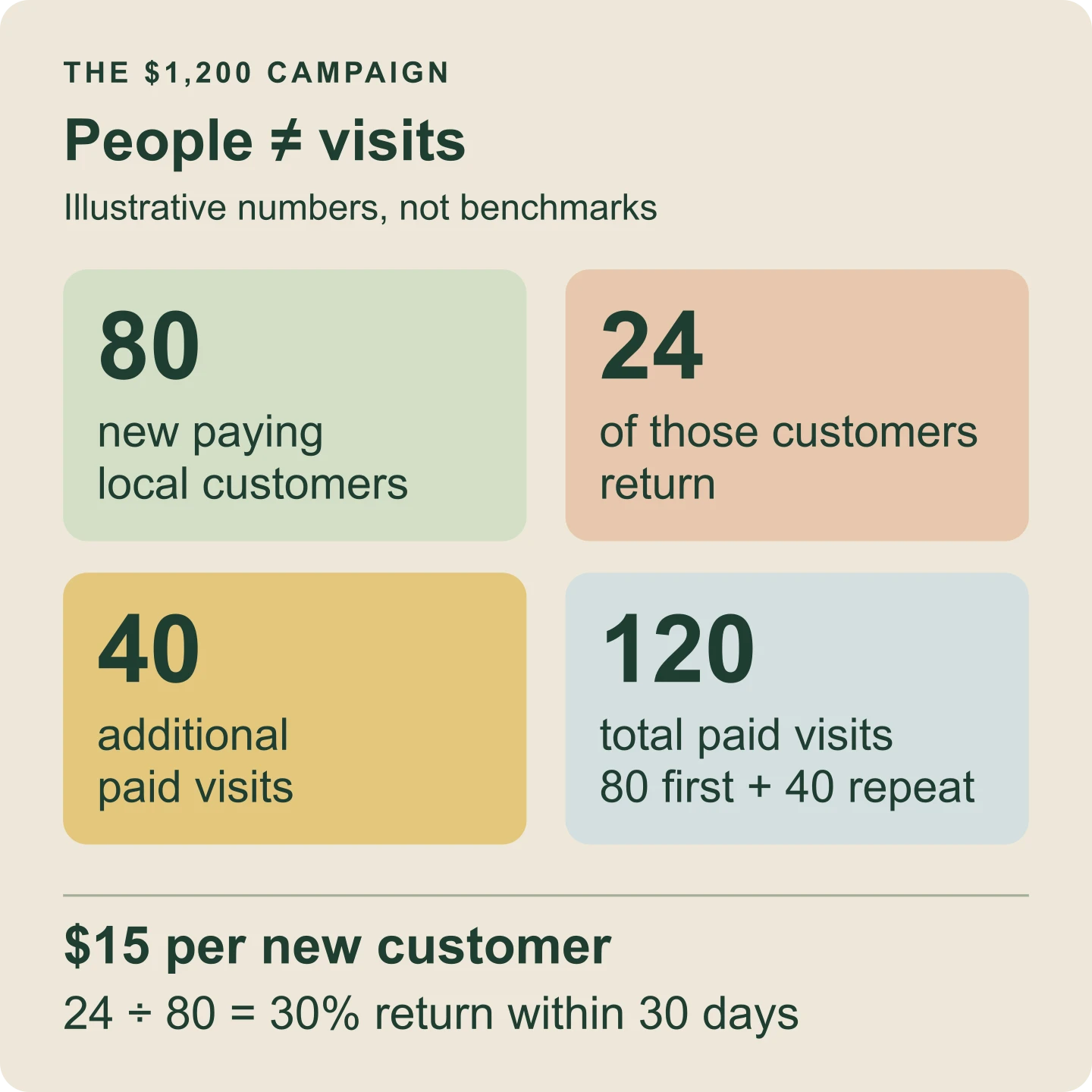
Suppose this hypothetical cycle brings 80 new paying local customers. Each has now had a complete 30 days after their first visit in which to return. Of those 80, 24 return, making 40 additional visits between them during their individual follow-up windows.
The arithmetic is:
- Acquisition cost per new paying customer: $1,200 ÷ 80 = $15.
- Customers returning within 30 days: 24 ÷ 80 = 30%.
- Campaign cost per customer who returned: $1,200 ÷ 24 = $50.
- Observed paid visits: 80 initial visits + 40 repeat visits = 120.
Now suppose the average visit leaves $10 of contribution after discounts, ingredients, disposables, transaction fees, and other costs that vary with that sale. The 120 visits contribute $1,200 before the campaign cost.
The test has recovered its $1,200 economic campaign cost in this simplified example. It has not paid the business's rent, ordinary payroll, or other fixed costs. It has also not demonstrated that every acquired customer was caused by the campaign.
Count each cost once. Complimentary products included in the campaign budget should not be deducted again from the paid visits. If incremental labor is already assigned to the campaign, do not also charge that same labor through the per-visit calculation.
Be cautious with future value
Do not justify today's spending by assuming a newcomer will visit twice a week for years. Start with observed contribution over a defined period, then update as more return behavior becomes visible.
Track locals separately from tourists or one-time regional visitors. Both can be valuable customers, but a weekend visitor should not be treated as a failed neighborhood regular.
With small numbers, compare several similar cycles and review the underlying customers and occasions. One unusually large group can move the average without proving that your next campaign will behave the same way.
12 Measure whether you are reaching new people
A new-market campaign needs to show whether it is introducing the category, earning visits, and building a repeatable business. You can start with a simple weekly sheet and consistent staff questions.
Keep the records small and useful
Record the visit date, first or repeat visit, broad source, local or visiting status when voluntarily known, and whether the guest says this is their first kava bar visit. Keep “unknown” as a valid answer. Do not turn ordering into an intake interview.
Where customers voluntarily use a loyalty or receipt system that supports repeat tracking, use its identifier. If you cannot reliably connect visits to a person, report aggregate counts and acknowledge that repeat attribution is incomplete. Do not manufacture a precise retention rate from staff guesses.
The weekly scorecard
| Measure | How to define it | What it helps answer |
|---|---|---|
| New paying local customers | Unique first-time paying customers who are local, using a consistent definition | Are we adding people who can return? |
| First-ever kava bar visitors | New guests who voluntarily report no previous kava bar visit; unknown kept separate | Are we introducing the category? |
| Attendance to purchase | Purchasing attendees divided by attendees under the same counting method | Did the event create commercial demand? |
| Return within 30 days | Customers who return within 30 days divided by the eligible first-visit cohort | Did the first experience lead to another visit? |
| Acquisition cost | Relevant campaign cost divided by attributed new paying customers | What did it cost to bring them in? |
| Observed contribution | Actual net sales less consistently assigned variable costs | Is the activity producing value after its direct costs? |
| Staff time per newcomer | Sampled explanation and hosting time, measured consistently | Can the experience scale with current staffing? |
For an extra habit measure, you might define an emerging regular as a local customer with three paid visits within 60 days. That is a working definition for your business, not an industry standard. Keep it stable long enough to compare cohorts.
Give every customer the same chance to return
Do not compare last month's fully observed customers with people who first visited three days ago. A 30-day return rate requires a full 30-day opportunity for every included first visit, or a clearly identified incomplete cohort.
Show the numerator and denominator. “6 of 20 eligible newcomers returned” tells the owner more than a lonely “30%” that hides the sample size.
Attribution needs the same restraint. A source code, a customer answer, and a link click are evidence about the path. They do not prove that the visit would never have happened without the campaign.
Ask a better review question
Invite honest feedback after real visits. Newcomers' own words can reveal confusing prices, unwelcoming moments, or explanations that worked.
Keep review requests separate from rewards and avoid steering people toward a particular rating or script. Google prohibits incentives for reviews and selective solicitation of positive reviews. Google Maps review policy.
Use feedback to improve the next visit. A recurring complaint about an unclear entrance is a sign to fix the entrance information, not to launch a campaign asking for more stars.
13 Run a 90 day launch and learning plan
Treat the timeline as a sequence of decisions. Move more slowly where approvals, service quality, or cash require it. An existing bar can begin at the first stage it has not actually completed.
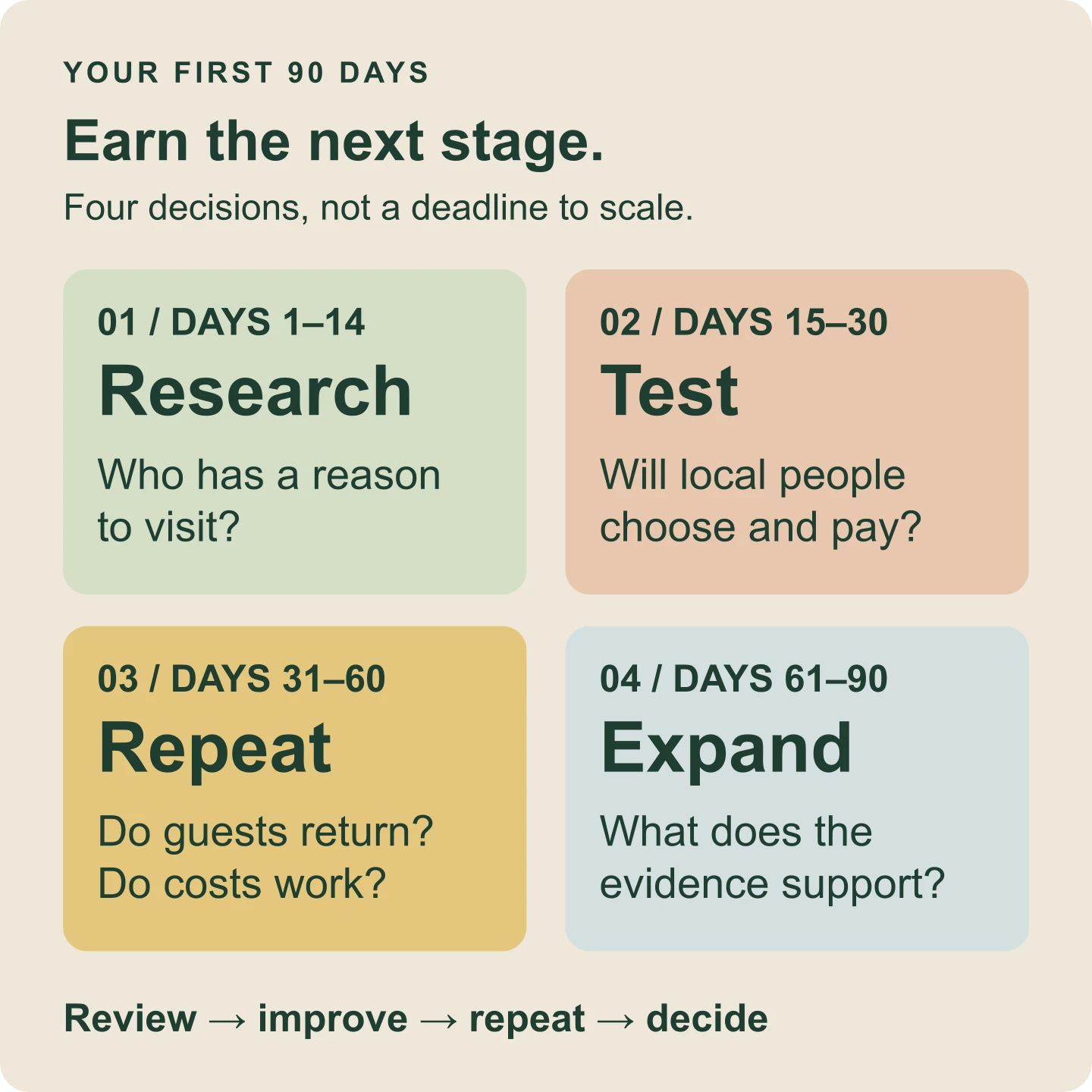
Days 1 to 14 Research and clarify
Interview local adults outside your current audience. Map their actual outings and the travel area your bar can serve. Choose one audience and one recurring occasion.
Write the short explanation, test it on people unfamiliar with kava, and build the first-visit information. Confirm that the proposed service and event can operate at the location. Set the budget, observation period, and reasons you would stop or change the test.
Decision to make: is there a specific group with a plausible reason to visit, and can you deliver that experience at a price worth testing?
Days 15 to 30 Run small paid tests
Invite a few relevant organizers to see the venue. Run a small number of comparable sessions with a named host, clear prices, and a ready second invitation.
Record who came, who paid, what they expected, and where the explanation broke down. Put the useful questions into the website, staff brief, and menu. Make operational changes before adding audience volume.
Decision to make: are unfamiliar local people willing to choose and pay for this visit, and can the staff welcome them properly?
Days 31 to 60 Repeat the strongest invitation
Keep the most promising occasion on a predictable schedule. Ask the best-fit partners to repeat it. Publish content that answers real questions from the first sessions.
If the visit path works, test a bounded amount of local paid distribution. Track early return cohorts once they have had enough time. Review cost and contribution with the same definitions each week.
Decision to make: does repeating the occasion bring customers back, and does its contribution justify another cycle?
Days 61 to 90 Expand what the evidence supports
Increase the strongest channel gradually. Test one adjacent audience or another session only if the current experience can absorb it. Protect ordinary service from event overload.
Separate the results of customers first acquired in different periods. If you track a 60-day habit measure, only the earliest eligible cohorts can have complete results by day 90.
Decision to make: should you expand the invitation, improve the offer, reduce the schedule, or change the underlying concept?
A sustainable weekly owner rhythm
Reserve a short weekly block to review the scorecard and customer questions. Use another block for partner conversations and invitation distribution. Brief staff before the event, then record the operational lessons while they are fresh.
Assign one person to keep the next two dates and public information correct. A dependable weekly routine is easier to improve than a marketing scramble that starts over every Monday.
14 Adjust the strategy to the geography
The size of the map changes the distribution problem. It does not change the need for a specific audience, understandable offer, and credible return path.
In a small town
Identify the gatherings and local communication channels people actually use. A community calendar, neighboring merchant, local paper, or recurring club may be more relevant than a large online audience.
Explain the venue plainly and show ordinary hospitality. Make pricing, age policy, and what happens inside easy to understand. Work with local schedules rather than assuming customers want a late-night pattern imported from another market.
In a larger city
Start with a neighborhood or travel corridor. A citywide following can disguise the fact that few people will cross town every week.
Build the first repeatable audience near the address. Measure travel friction, evening access, and competing occasions. Expand beyond that area when a particular event is worth the trip and the customer response supports it.
Across a region or state
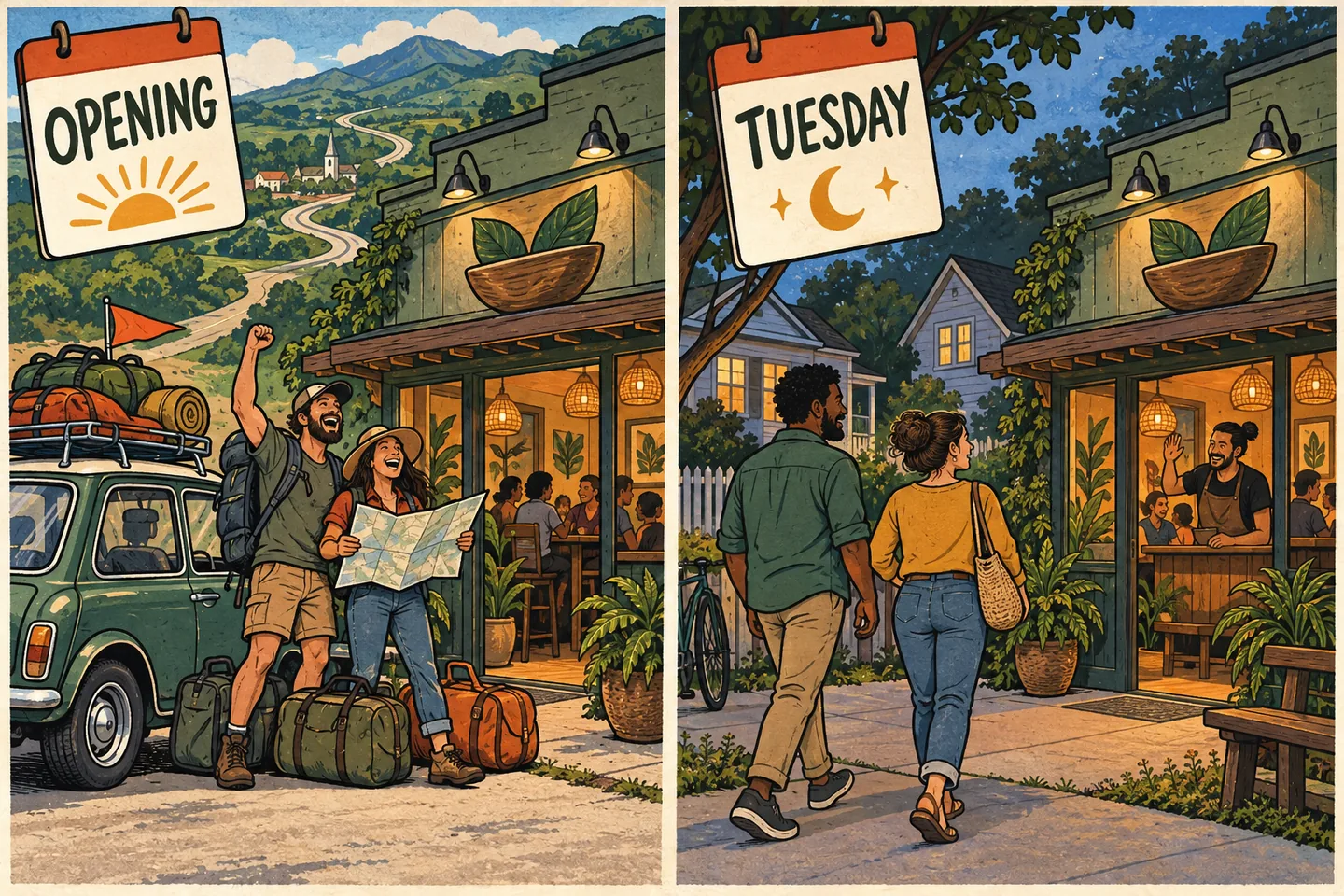
Separate destination visits from routine visits. A regional story, tourist itinerary, or unusual event can introduce you to people who travel farther. Their visit may be profitable without becoming weekly behavior.
Keep a local acquisition plan underneath the publicity. “People drove two hours to our opening” is encouraging; it does not establish demand for your Wednesday shift.
If you operate several locations, let each location learn its own audience and schedule. Share good explanations and operating materials, then adapt the invitations to actual local behavior.
In an established kava market
Keep serving experienced customers, but give unfamiliar residents an entry point that does not require knowing the culture already. Test an occasion or partner group outside your usual kava audience.
Measure first-ever kava bar visitors separately from customers moving between bars. Both matter, but only the first tells you directly that the campaign is introducing new people to the category.
15 Diagnose the problem before spending more
The most useful marketing question is often “Where did the next step stop happening?”
| What you see | What to investigate | A useful next test |
|---|---|---|
| People cannot explain what the business is | Concept language, photos, signs | Rewrite the short introduction and repeat the stranger test |
| Lots of questions but few visits | Price, timing, access, relevance, unclear next step | One specific invitation with complete visit details |
| Plenty of free interest but few purchases | Willingness to pay, offer design, audience fit | A small paid experience at a transparent price |
| A good first event followed by silence | Missing next occasion, weak follow-up, inconsistent service | The same useful event with a clear return invitation |
| Partner attendees return only with the partner | Dependence on that organizer or activity | A bar-hosted follow-on session for the same interest |
| Newcomers arrive but staff become overwhelmed | Menu clarity, hosting capacity, staffing | A simpler introduction and smaller arrival group |
| Customers like the visit but rarely return | Distance, schedule, value, occasion frequency | A better-fitting time or a more local audience |
| Events are busy but contribution is weak | Costs, discounts, purchases, displaced regular trade | Reprice or simplify one event and compare the full economics |
| Existing regulars feel pushed out | Seating, noise, schedule, capacity | Adjust event boundaries and protect predictable ordinary hours |
Give a test enough comparable repetitions to learn, within the loss limit you set. Persistent weak response is information. A pioneer does not owe the market unlimited cash while waiting for it to catch up.
Sometimes the answer is a clearer explanation. Sometimes it is different hours, better hosting, a different audience, or a menu that works for more of the group. Sometimes the concept, price, or location needs to change.
16 Write your next experiment on one page
Copy this brief before launching another campaign. It should be specific enough that a staff member can run the visit you promised.
| Field | Fill this in |
|---|---|
| Audience | The local people we want to reach and how close they are |
| Existing occasion | What they already do or want to do |
| Current alternative | Where they go now, including staying home |
| Our promise | One clear reason our visit fits that occasion |
| Kava explanation | The short, accurate introduction we will use |
| First visit | Date, time, price, age policy, activity, and access details |
| Drink choices | Clearly identified kava and non-kava options |
| Distribution | The partner or channel that can reach this audience |
| Owner and host | Who promotes it, welcomes people, and records results |
| Capacity | How many newcomers we can serve well |
| Return invitation | The next relevant date already on the calendar |
| Cost limit | Cash budget plus the staff and owner time we will count |
| Success and stop rules | What result earns another test and what makes us revise |
| Review date | When we will assess first visits and when return data will mature |
A complete invitation template
[Activity] at [bar] in [neighborhood]
Looking for [specific social occasion]? Join us on [day] from [start] to [end]. We are a kava bar with [accurate description of the space and drinks]. New to kava? Staff can explain the menu, and [non-kava choices] are available too.
[Explain the activity and how solo arrivals join.] [State price, purchase requirement, age policy, and booking rules.] See the menu, entrance, parking, and access details at [link].
Every bracket is a question to answer before publication. Remove an unsupported promise instead of leaving it for staff to improvise.
Questions owners ask about marketing in a new area
Can a kava bar succeed where nobody knows kava?
Low awareness creates an education task; it does not prove either success or failure. Test whether nearby people will pay for the visit and return, then compare the contribution with the costs of acquiring and serving them.
Should we remove kava from the business description?
Keep the product identity clear and explain the setting in familiar language. “Kava bar and alcohol-free social space” can communicate more than “kava bar” alone when both parts accurately describe the business.
Should every promotion begin by explaining kava?
An invitation can begin with the occasion, such as a hosted game night, while clearly identifying the business and available drinks. Put a short explanation on the destination page and make fuller product information available before ordering.
Is a free first drink the best way to build the market?
A free offer can attract curiosity, but you still need to learn whether people value the visit enough to pay and return. Compare its full cost and observed repeat behavior with a clearly priced introductory experience.
How long should local education take?
There is no reliable timetable that applies to every location. Use bounded learning cycles with spending limits, and look for improvements in understanding, paid first visits, and eligible return cohorts instead of waiting indefinitely for awareness to grow.
Should we advertise to people who already drink alcohol?
You can invite adults to a social occasion without requiring them to adopt a new identity or abandon other venues. Describe the experience and drink options accurately, and let customers decide which occasion fits their preferences.
What if guests come for the event and never order kava?
Assess whether their purchases, repeat visits, and effect on the venue support the business. A profitable, engaged customer choosing a non-kava drink can still help build the gathering place you intended; if you need kava sales specifically to sustain the model, measure that separately.
What should a new owner do first this week?
Talk to local people about their actual outings, choose one plausible audience, and test a clear invitation to a small paid experience. Complete the one-page brief above before committing more money.
Pick the next date. Give someone responsibility for hosting it. Make the invitation understandable to a person who has never heard the word kava.