

1. Decide what the event is supposed to do
Kava bar events work best when they solve a real social problem: somewhere to meet after work, a game you can join without bringing a team, a stage with a predictable signup process, or a quiet activity that does not require constant conversation.
“Get more people in” is too broad to guide the format. Choose a job you can observe: introduce nearby residents to the bar, fill an underused Tuesday, help newcomers meet someone, or give an existing group a reliable home. One event may do several things eventually. Pick one primary job for the first test.
Then write the promise from the guest's point of view. “Beginner board games with a host who helps solo arrivals find a table” is clearer than “Community game night.” The first tells someone why they can comfortably show up without already knowing everybody.
Check the constraint before booking. Is the problem awareness, an unclear offer, an awkward arrival, a poor time slot, unreliable hosting, or genuinely weak demand? Advertising cannot repair a night that nobody knows how to join.
2. Choose an event your bar can host well
Start with the people, space and staff you have. The following formats are operating suggestions, not claims that any one format guarantees attendance. Choose the smallest version that delivers the promise.
| Format | Best starting audience | What the host must do |
|---|---|---|
| Beginner game tables | Adults who want an activity and may arrive alone. | Teach short games, group arrivals and keep a newcomer seat available. |
| Hosted trivia | Small friend groups plus solo guests willing to join a team. | Explain rules, form a house team and maintain a predictable pace. |
| Open mic | Local performers and listeners who value a welcoming stage. | Manage signup, time limits, sound checks and transitions. |
| Quiet craft or reading meetup | People seeking company without constant social performance. | Explain supplies, quiet periods and optional conversation breaks. |
| Neighborhood welcome hour | Residents curious about the bar and what it serves. | Offer a brief introduction, transparent menu choices and easy conversation. |
| Partner workshop | A specific local group with a reason to learn together. | Confirm the instructor, materials, cost, capacity and what guests will leave with. |
Operating card: beginner game tables
Start with games the host can explain quickly and reset between groups. Keep pieces complete, provide a clean surface and separate drinks from vulnerable materials. Put the welcome point where arrivals can see it. A host who spends the whole night competing at one table has stopped hosting.
Plan the first round so a late arrival can join a later round. A ninety-minute game beginning at the advertised start can leave someone arriving ten minutes late stranded for most of the evening. Measure arrivals, successful placements, abandoned arrivals and next-date interest.
Operating card: hosted trivia
Publish the actual start, expected finish, team arrangements and any entry charge. Prepare the question set, answer method, tie-break and prize before guests arrive. Invite solo players to a house team without making their arrival a public announcement.
Schedule ordering breaks and agree on sound levels with staff. Reward the game, not rapid drink consumption. If the same expert team wins every week, adjust the experience with approachable rounds or a separate beginner format rather than secretly changing results.
Operating card: open mic
State signup time separately from performance time. Tell performers the set length, content expectations and available equipment. Test the microphone and transitions before opening the list. Assign someone who can enforce time limits politely.
Protect the listener experience too. A performer who brings friends should not have to wait through an unexplained two-hour delay. Check the venue's arrangements for music, sound and operating hours before committing to a format. A clear running order is part of the product.
Operating card: quiet meetups and workshops
For crafts or reading, explain whether people bring supplies and whether conversation is optional. Show where to sit. A quiet meetup still needs a host; otherwise a newcomer cannot tell whether the group has started or whether the table belongs to a private party.
For a partner workshop, write down who supplies materials, handles bookings, collects payment and deals with cancellations. Confirm the instructor can deliver the actual activity. “They have lots of followers” is not a substitute for teaching ability or a reliable arrival time.

3. Budget the test before announcing it
Separate three views: sales during the event, contribution after variable costs, and the incremental result compared with an ordinary comparable evening. Revenue alone does not tell you whether the event helped.
Start with net event-period sales, excluding tax and tips. Subtract product, packaging and payment costs to get contribution. Then subtract event-specific expenses: host, added labor, prizes, materials, promotion, ticket fees not already counted, and cleanup. Compare with the contribution the same period would likely have produced without the event.
Incremental event result = event-period contribution − comparable baseline contribution − extra event costs.
Use several comparable dates where possible. Weather, holidays, opening hours and overlapping promotions can change the comparison. The result is an estimate of the event's effect, not a controlled experiment.
| Worked example | Amount | Interpretation |
|---|---|---|
| Event-period contribution | $400 | After product, packaging and payment costs. |
| Comparable ordinary-period contribution | $180 | The business you might have earned anyway. |
| Extra event costs | $160 | Host, added staff, materials and other incremental spending. |
| Estimated incremental result | $60 | Four hundred less one hundred eighty less one hundred sixty. |
The example uses invented planning numbers. The calculator lets you replace them. Keep baseline labor in the ordinary operation and put only additional labor in event costs; otherwise you subtract the same expense twice. The profitability guide explains the wider contribution model.
A deliberately subsidized community event can be a reasonable choice. Give it a budget and a purpose. If the plan relies on future visits to recover the cost, record those visits over a full observation window instead of calling every conversation a future customer.
4. Give the host a one-page brief
The host is responsible for participation. The kavatender is responsible for service. Sometimes one person can do both during a small test, but make that an explicit staffing decision. When orders start backing up, somebody still needs to greet the person standing beside the game table.
- Promise: who this is for and what they can expect.
- Timing: setup, arrival window, start, breaks, finish and cleanup.
- Arrival: where guests check in and how solo or late arrivals join.
- Capacity: usable seats, materials and the maximum the host can manage.
- Boundaries: house rules, behavior concerns and the shift lead's contact.
- Money: fee, inclusions, spending authority and payment arrangements.
- Backup: substitute host, missing equipment and cancellation decision time.
- Afterward: counts, expenses, observations and the next-date invitation.
Read the brief together before the first event. Ask the host to explain what they will do if three solo guests arrive late or only four people attend. You learn more from that answer than from another discussion about the poster design.
If a partner is bringing an audience, define the work: which channels they will use, when invitations go out and who answers questions. Do not book a night around an undefined promise to “promote it everywhere.”
5. Design the first five minutes
A newcomer arriving alone is making a small social bet. They need to locate the event, recognize the host and understand their next step without interrupting a group of strangers.
Use a simple sign, an identifiable host and a clear welcome point. “Here for games? I'm Maya, the host. We have a beginner table starting in a few minutes. Would you like to join that one?” is enough. Do not require a speech, personal disclosure or participation in an icebreaker before someone can sit down.
“You can join this round, watch first, or take a quieter seat. I'll check back before the next game starts.”
Build late arrival into the format. For games, use short rounds. For trivia, explain how a new team can join. For a workshop, state the latest useful arrival time in advance. “Drop in anytime” should only appear when the activity genuinely supports it.
Leave a path for ordinary guests who did not come for the event. Explain sound levels and seating changes. A successful event should not surprise your usual quiet-evening customers with a microphone beside their laptop.
Use the kavatender handbook to practice the host-to-counter handoff. When a new guest also needs a menu explanation, the two jobs should cooperate instead of leaving the person bouncing between them.
6. Promote a clear invitation on a realistic timeline
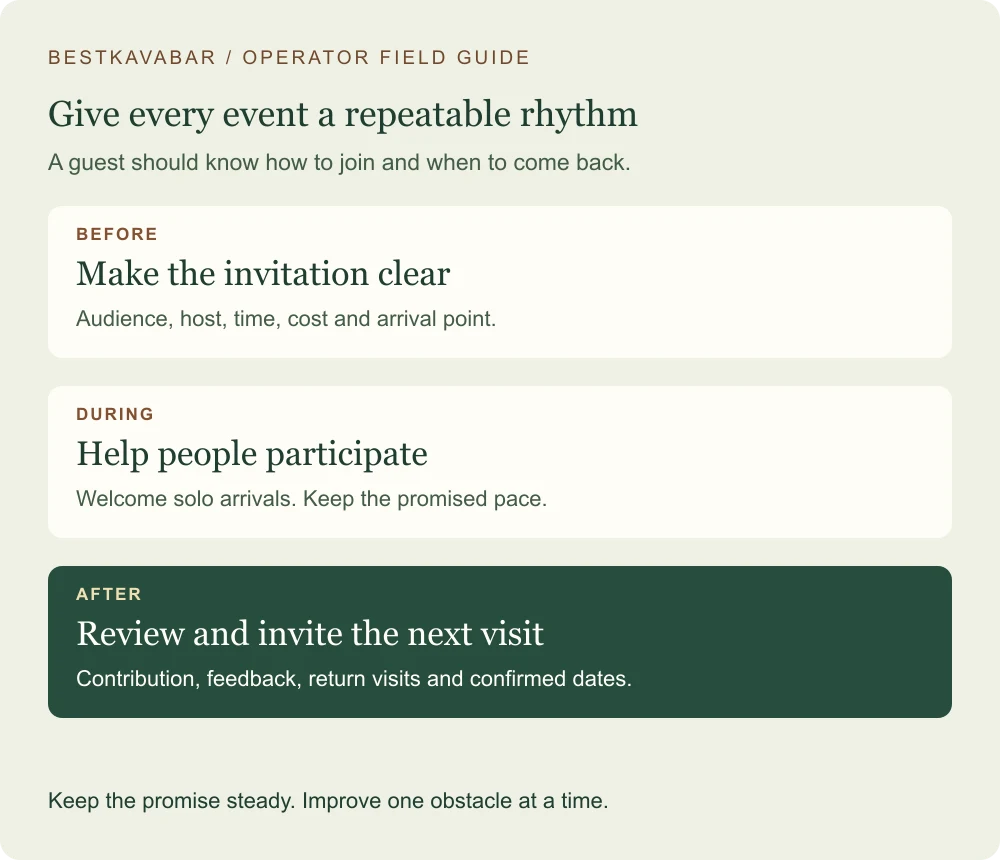
Tell people who the night is for, what happens, when it starts and ends, what it costs, and how to join. Include the full address and any age, booking, supply or accessibility details that affect attendance. A pretty poster cannot answer a question it never includes.
For a new-market audience, explain the setting without making the event description a lecture about kava. “A beginner game night at our neighborhood kava bar, with nonalcoholic menu options and a host who helps you find a table” gives a person a reason to investigate. Describe the actual menu; do not promise options the bar does not offer.
| When | Action | Check |
|---|---|---|
| About two weeks before | Confirm host, format, budget, date and the main event page. | One person owns corrections and cancellations. |
| One week before | Invite relevant groups and give staff a short explanation. | The invitation answers the basic attendance questions. |
| Two days before | Remind interested guests and confirm supplies and staffing. | Every published version agrees on time and cost. |
| Event day | Publish the accurate final reminder and set up the welcome point. | The host and counter team know the arrival plan. |
| Within two days after | Review costs and feedback; share the next confirmed date. | Follow-up goes to people who asked to receive it. |
For recurring dates, keep the time and promise stable long enough for people to learn them. Change one element when a test needs improvement. If everything changes every week, both customers and your own measurement lose the thread.
HappyKava can help make current events discoverable. Keep the details on the bar's event listing aligned with the website and staff script. The HappyKava website widgets can display the published calendar on your site. A distribution tool still needs an accurate event and a host who delivers it.
7. Make the small version good
Four people showing up is not automatically a failure. Four people arriving to find a disappointed host, empty rows of chairs and no plan is a bad experience. Scale the setup to the people present.
For games, create one welcoming table. For a craft meetup, make it a hosted session rather than a silent waiting period. For trivia, use the small-group version you prepared. Avoid repeatedly apologizing for attendance; guests who came deserve an evening that starts.
Decide minimum attendance and cancellation terms before selling a workshop that needs a certain group size. If cancellation is necessary, notify registered guests through the channel they used, update every listing and explain any refund or rescheduling process. Do not leave a canceled event looking active online.
Record where turnout failed. Did people see the invitation? Did they understand it? Did interested people forget, choose another time, or arrive and leave? These require different changes. “Nobody likes events here” is a large conclusion to draw from one weakly promoted Tuesday.
8. Run the night with a simple sequence
Use the same sequence often enough that the host and counter team stop improvising basic logistics. The following is a ninety-minute activity example; adjust the timing to the actual format.
- Thirty minutes before: host and lead check equipment, seating, supplies, menu availability and the arrival plan.
- Fifteen minutes before: open the welcome point, greet arrivals and explain where to order.
- At the start: state the activity, finish time, breaks, rules and how someone can join late.
- During the first block: help people participate and watch for confusion or isolation.
- At the break: make space for orders, check sound and handle any seating problem.
- Before the finish: invite guests to the next confirmed date without interrupting the activity.
- Afterward: clean up, record counts and expenses, and debrief with the shift lead.
Have a named backup for a missing host. If nobody can deliver the advertised activity, communicate the change instead of pretending the ordinary bar service is equivalent. Protect exits, accessible paths and the counter queue when rearranging furniture.
Ask before photographing identifiable guests for promotion. Make it easy to enjoy the activity without being included in the recap. A community night should not feel like a content shoot people accidentally attended.
9. Build a calendar people can remember
Begin with one recurring anchor event and enough ordinary evenings to run the bar well. Add a second format only when the first has a reliable host and the staff can support both. A calendar filled with seven untested concepts creates seven different operational problems.
Use a four-date pilot. Date one establishes the baseline. Date two fixes the biggest arrival or service problem. Date three tests one promotion channel or format adjustment. Date four reviews the pattern and decides whether to continue, change or stop.
The planner above creates four weekly dates from your chosen start date and attaches the same operational checklist. It is a planning draft, not an automatic event publication. Confirm holidays, local conflicts, host availability and the venue's time zone before announcing the dates.
Keep seasonal or one-off events separate from the anchor. A special launch can attract a different crowd from a weekly meetup. Judge each against its own purpose instead of expecting every ordinary week to repeat opening-night attendance.
10. Measure who returns and what the night adds
Record attendance, first-time guests when voluntarily identified, net sales, contribution, extra costs, host hours and service issues. Keep counts defined the same way each week. An RSVP is intent; a person who arrives is attendance.
For repeat visits, define the group and the window. If you want to know how many first-time event guests return within thirty days, allow each guest the full thirty days before finalizing the rate. Track only what you can reliably observe through your existing consent-based records; unknown is not the same as did not return.
Ask one useful question at the end: “What would make this easier to come back to?” Timing, sound, unclear rules, an unwelcoming group or a missing beginner option may matter more than another prize.
| Decision | Evidence | Next action |
|---|---|---|
| Keep | Guests return, hosting is reliable and the cost fits the goal. | Confirm the next dates and protect consistency. |
| Change | People show interest but one fixable obstacle repeats. | Change that obstacle and keep the rest stable. |
| Pause | Delivery is unreliable or the test exceeds its budget. | Resolve the constraint before making another promise. |
| Stop | Repeated tests show weak fit and no credible improvement path. | Thank participants, close the listings and choose a better use of time. |
For broader acquisition, connect the night to the new-market marketing plan. For the welcome and next invitation, use the first-visit retention guide. The event is one part of that relationship, not a substitute for ordinary good service.
Questions owners ask about kava bar events
What are the best events for a small kava bar?
Choose a format that fits the available space, audience and host: beginner games, a quiet meetup, small trivia or a focused workshop can be manageable starting points. Test the smallest version that delivers the promise.
How often should a kava bar run events?
Start with one reliable recurring event and review a four-date pilot. Add more only when hosting, service and demand support them. Consistency matters more than filling every night.
Should events be free or ticketed?
Use the costs and guest promise to decide. A simple meetup may work without admission; a materials-heavy workshop may need a ticket. Publish what the price includes and how cancellations work before people book.
How do I know whether an event made money?
Compare event-period contribution with a comparable ordinary period, then subtract additional event costs. Track the longer-term return visits separately so a hoped-for future benefit does not disguise today's expense.
What if almost nobody comes?
Deliver the small version well, then diagnose awareness, timing, invitation and arrival. A weak first turnout is information. Repeatedly running the same failed setup without changing a specific cause is expensive.
Book one test you can deliver
Choose the audience, confirm the host, set the budget and write the invitation in one clear paragraph. Build the arrival plan before the poster. Then run the night well enough that the people who came can confidently invite someone next time.